About Lanius senator Linnaeus, 1758
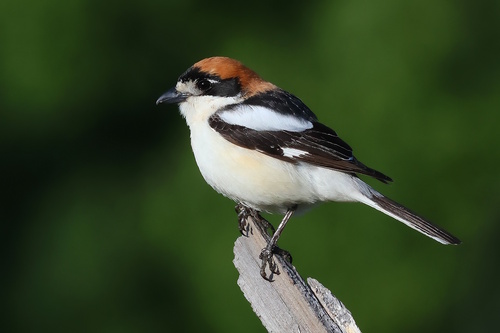
The woodchat shrike, Lanius senator Linnaeus, 1758, measures 17–19 cm (6.7–7.5 in) in total length, making it slightly larger than the red-backed shrike. Breeding males have bold black and white upperparts, a chestnut crown, and clean pure white underparts. The western Mediterranean subspecies L. s. badius does not have the large white wing patches found in other populations. Females and juvenile woodchat shrikes have brown and white vermiculated upperparts, with buff vermiculated underparts. This species breeds across southern Europe, northern Africa, and the Middle East. Its breeding range stretches from Portugal east to Greece, Turkey, Iraq, and Iran, and includes Bahrain and Kuwait on the Arabian Peninsula; in northern Africa it extends from Mauritania and Western Sahara east to Libya. Woodchat shrikes overwinter in tropical central Africa, with their winter range reaching from Senegal east to Sudan and Ethiopia, and south to Gabon. During spring migration, individuals often travel beyond the species' breeding range, making the woodchat shrike a rare but annual visitor to Great Britain. The Balearic subspecies badius has been recorded as a vagrant in Britain around four times, and has been documented once in Ireland. The woodchat shrike feeds primarily on insects, especially beetles, but may also eat other invertebrates, and very occasionally small mammals and small birds. It hunts from an exposed exposed perch such as a tree branch or fence, usually 2–6 m (7–20 ft) above ground, then drops or glides down to capture prey. It also performs short sallying flights to catch flying insects. Small insects are crushed in the bird's bill, while larger insects are taken apart. While impaling prey on thorns has been observed in this species, this behavior is uncommon. The woodchat shrike regurgitates indigestible materials like chitin, bones, and hair in the form of pellets.