About Lanius schach Linnaeus, 1758
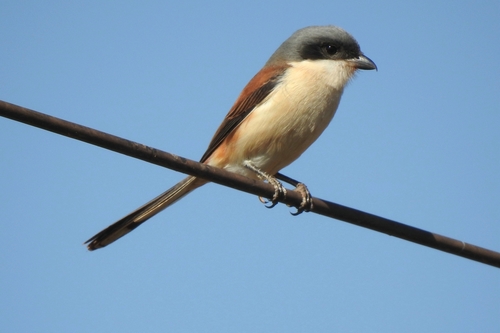
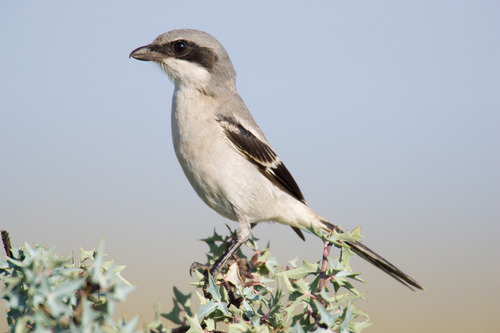
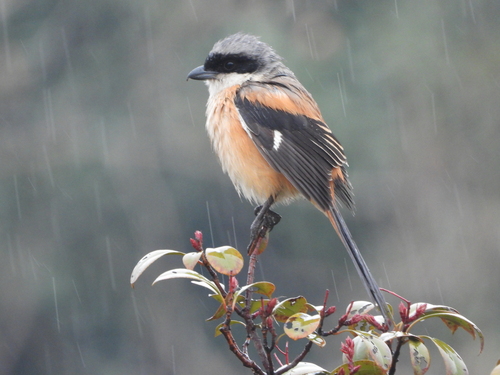
This species, commonly called the long-tailed shrike, is a typical shrike that favors dry open habitats and perches prominently on top of bushes or wires. Most subspecies have a broad dark mask running through the eye that covers the forehead, while the tricolor and nasutus subspecies have entirely black heads. The narrow, graduated tail has pale rufous coloring on its outer feathers. The subspecies erythronotus has grey mantle and upper back feathers suffused with rufous, while the caniceps subspecies from southern India has pure grey mantle and upper back feathers. There is a small patch of white at the base of the primaries. The related bay-backed shrike is smaller, has more contrasting patterning, and has a more prominent white wing patch. Male and female long-tailed shrikes have identical plumage. The long-tailed shrike occurs across Asia, ranging from Kazakhstan to New Guinea. It lives primarily in scrub and open habitats, including scrub, grassland, and open cultivated land. Many populations in temperate zones are migratory, traveling south for winter, while tropical populations are mostly sedentary, though they may make short-distance movements. The caniceps subspecies of southern India occurs in the dry coastal zone of southern India during winter, while the tricolor subspecies migrates south to Bengal, India. A survey in southern India found this species to be one of the most common wintering shrikes, with a linear roadside density of around 0.58 individuals per kilometer, and that the birds often choose wires for perching. It is a rare vagrant to western Europe, with two accepted records: one from Great Britain on South Uist in November 2000, and one from the Netherlands near Den Helder in October 2011. A bird matching the features of the caniceps subspecies has been sighted on the Maldives, and the species has also occurred as a vagrant in Jordan, Israel, and Turkey. When perching on bushes, long-tailed shrikes hold the characteristic upright posture typical of shrikes. They glide down at an angle from their perch to capture prey including lizards, large insects, small birds, and rodents. They maintain feeding territories and are usually found alone, with mated pairs spaced well apart. Multiple individuals have been observed engaging in playful behavior, fighting over perches. Their common calls are harsh grating scolds, described as similar to the squeal of a frog caught by a snake. They are capable of vocal mimicry, and include the calls of species like lapwings, cuckoos, puppies, and squirrels in their song. This singing ability makes the species a popular pet in parts of Southeast Asia. Long-tailed shrikes hunt a wide variety of animal prey. They have occasionally been observed catching fish from streams, and also eat small snakes. They sometimes practice kleptoparasitism, stealing prey from other birds, and will catch flying insects mid-air. After feeding on just the head or brain of prey, they sometimes impale the remains on a thorny bush. In Kerala, they have been reported feeding on neem fruits, and will even attempt to impale these fruits on twigs. In temperate ranges, breeding occurs in summer. The nest is a deep, loose cup constructed from thorny twigs, rags, and hair, and is placed in a thorny bush or tree such as Flacourtia or wild date palms (Phoenix). A typical clutch holds 3 to 6 eggs, which are incubated by both parent birds. Eggs hatch after 13 to 16 days. Parents feed young chicks pieces of captured small birds. A second brood may be raised in the same nest. Long-tailed shrike nests are sometimes parasitized by cuckoos, including the common cuckoo (recorded in Dehra Dun), common hawk-cuckoo, Jacobin cuckoo, and the Asian koel in Bangladesh.