About Lanius nubicus Lichtenstein, 1823
The masked shrike, Lanius nubicus Lichtenstein, 1823, is the smallest species in its genus, with a slender build. Adults typically weigh 20–23 g (0.71–0.81 oz), measure 17–18.5 cm (6.7–7.3 in) in length, and have a wingspan of 24–26.5 cm (9.4–10.4 in). This species has a long tail and a relatively small bill, with a tomial tooth on each side of the bill: the upper mandible has a triangular ridge that fits into a matching notch on the lower mandible, an adaptation otherwise only seen in falcons.
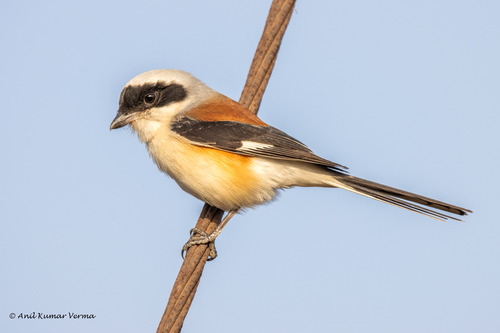
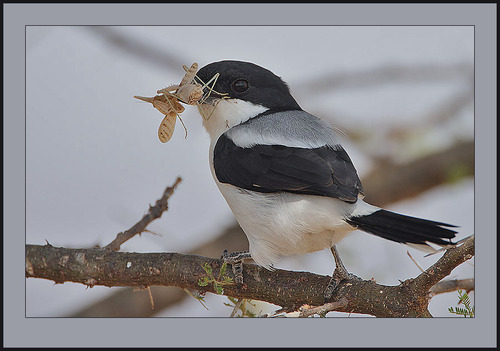
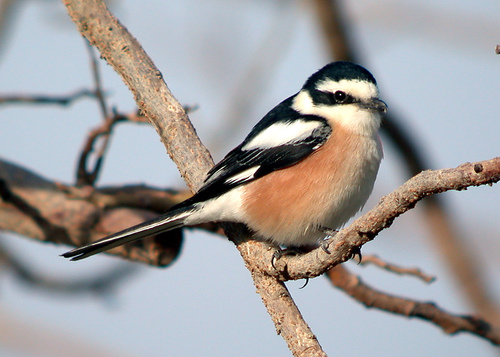
Males have mostly black upperparts, with a white crown, forehead, and supercilium. They have large white patches on their shoulders and primaries, and their outermost tail feathers are also white. Their throat, the sides of their neck, and their underparts are white, with orange coloring on the flanks and breast. Males have brown irises, black bills, and dark brown or black legs. Females are a duller version of males, with brownish-black upperparts, and a grey or buff tint to their white shoulder patches and underparts. Juveniles have grey-brown upperparts with darker barring from the head to the rump, a paler grey forehead, barred off-white underparts, and brown wings with white primary patches.
Masked shrikes are most similar in appearance to woodchat shrikes, but are smaller, more slender, and longer-tailed. Adult masked and woodchat shrikes are easily distinguished: masked shrikes have white on the head and a dark rump, while woodchat shrikes have a black crown, rusty nape, and white rump. Juveniles of the two species are more similar in appearance, but juvenile masked shrikes have a longer tail, paler face, and grey back and rump, compared to the sandy back and pale grey rump of juvenile woodchat shrikes.
Juvenile masked shrikes moult their head, body, and some wing feathers a few weeks after fledging, while adults undergo a complete moult after breeding. In both age groups, if the moult process is not finished before migration begins, it is suspended and completed on the wintering grounds.
The masked shrike is a migratory species that breeds in the Balkans and Western Asia, including southern Bulgaria, eastern Republic of North Macedonia, northeast Greece and some Greek islands, Turkey, Cyprus, from Syria south to Israel, eastern Iraq, and western Iran. Its eastern range is uncertain, and may also include Afghanistan and northern Saudi Arabia. It winters south of the Sahara, mainly in Chad, Sudan, and Ethiopia. Smaller numbers are found as far west as eastern Mali and Nigeria, and also in northern Kenya and southern Saudi Arabia. Most birds leave their breeding grounds in late August and September, and return north in February and March. This species is seen in Egypt, Jordan, and Israel far more often in spring than autumn, which suggests its southbound migration route is concentrated further east. During migration, individual birds hold small territories of around 0.5 hectares (1.2 acres), and unlike other shrikes, masked shrikes may gather in large groups. Over 100 individuals have been recorded at a single site in Israel, with five birds found in a single bush. The masked shrike has occurred as a vagrant in Algeria, Finland, Kenya, Libya, Spain, Sweden, Mauritania, Turkmenistan, Great Britain (with at least three documented individuals), and Armenia (with two documented individuals).
The masked shrike's preferred breeding habitat is open woodland with bushes and some large trees. Unlike other shrike species, it avoids very open, lightly vegetated terrain. It also uses orchards and other cultivated land that has suitable old trees or large hedges, and normally occurs in more wooded areas than shrike species that share its range. It is found in lowlands and hills up to 1,000 m (3,300 ft), and can breed at altitudes as high as 2,000 m (6,600 ft) in some regions. During migration, it may appear in gardens and resorts. In its winter range, it again prefers open country with thorny bushes and large trees such as acacia or introduced eucalyptus.