About Lanius minor Gmelin, 1788
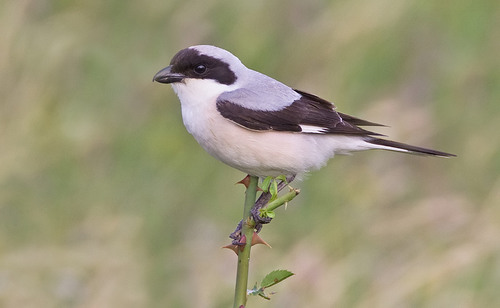
This is the lesser grey shrike, with the scientific name Lanius minor Gmelin, 1788. Adult males have black nape, cheeks, ear coverts, eye coverts, and the front portion of the crown. The back of the crown and the back are pale bluish-grey, and the rump is a similar but noticeably paler shade. Underparts are white, with pink suffusion across the lower breast and belly. Axillaries are greyish-white, and underwing coverts are brownish-black. The two central tail feathers are black, with white tips and bases. Other tail feather pairs have increasing amounts of white and decreasing amounts of black. Primaries are black with buff tips and white bases. Secondaries are black with broader, paler tips, and have no white bases. Wing coverts are black, with lesser coverts fringed with grey. Females have similar plumage, but their heads are dark grey rather than black, ear coverts are brownish-black, upperparts are brownish-grey, and underparts have less pink than males. Juveniles resemble adults but are overall more brown. They lack the grey back and rump; instead these areas are pale brown, faintly barred, and underparts are white and cream with no pink. All individuals have a brownish-black beak with a paler base on the lower mandible, brown irises, and black legs and feet. Adults reach a length of roughly 20 cm (7.9 in), with a wing length of 13 cm (5.1 in) and a tarsus length of 2.5 cm (1 in). As a migratory species, the lesser grey shrike spends the summer in South and Central Europe and western Asia, where it breeds. Its breeding range in Europe includes southern France, Switzerland, Austria, Hungary, Slovakia, Czech Republic, Italy, the former Yugoslavia, Albania, Greece, Romania, Bulgaria, Ukraine, and southern Russia. In Asia, it breeds across the Middle East, with its range extending as far east as eastern Turkey and Iran. It occurs as a vagrant in more northerly parts of Europe, most often during spring or autumn; it has been recorded in Sweden, Finland, Denmark, the United Kingdom, the Netherlands, Belgium, and northern France. It winters across a broad belt of tropical southern Africa. In the summer, the lesser grey shrike lives in open countryside, edges of cultivated areas, heathland with scattered bushes and trees, gardens, coppices, woodland, and roadside trees. In its winter range, it is most commonly found in scrubland and among thorn trees.