About Lanius ludovicianus Linnaeus, 1766
The loggerhead shrike (scientific name Lanius ludovicianus Linnaeus, 1766) is a medium-sized passerine bird. Its common name "loggerhead" refers to its unusually large head relative to the rest of its body. On average, its wings measure about 3.82 inches (9.70 cm) long, and its tail measures about 3.87 inches (9.83 cm) long. Healthy adult loggerhead shrikes weigh an average of 1.8 oz (50 g), with an individual weight range of 1.6–2.1 oz (45–60 g). The full published measurement range for the species is: total length 7.9–9.1 in (20–23 cm), weight 1.2–1.8 oz (34–51 g), and wingspan 11.0–12.6 in (27.9–32.0 cm).
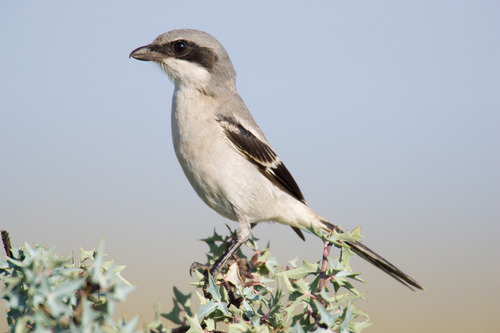
Adult loggerhead shrikes have grey plumage on their upper bodies, with a white to pale grey breast and black tarsi and feet. They have a distinct black mask that extends across the eyes to the bill. Their wings are black with a clear white patch on the primary flight feathers. Their tail is black with white edges, and their irises are brown. The beak is short, black, hooked, and has a tomial tooth that helps the bird tear into prey. Adult loggerhead shrikes are sexually monochromatic, meaning males and females cannot be easily told apart by plumage in the field, though multiple studies have found sexual dimorphism in both plumage details and size. Juvenile loggerhead shrikes have paler grey plumage with subtle vermiculation.
The loggerhead shrike can be told apart from the northern shrike by its smaller body size, darker grey plumage, larger black face mask that fully covers the eye, and a shorter bill with a less prominent hook. The calls of the two species are similar.
Loggerhead shrikes were once widely distributed across southern Canada, the contiguous United States, and Mexico, but their populations have declined sharply since the 1960s. Four subspecies are found in southern coastal California: mearnsi, gambeli, grinnelli and anthonyi. L. l. mearnsi occurs only on San Clemente Island, California; L. l. gambeli breeds on the California mainland; L. l. anthonyi breeds on the California Channel Islands. L. l. excubitorides is found in central North America, while the non-migratory nominate subspecies L. l. ludovicianus lives in southeastern North America. The range of L. l. migrans covers northern to eastern North America, and this range has been shrinking since the 1940s.
Loggerhead shrikes need open habitat that includes space for foraging, elevated perches, and nesting sites. They are most often found in open pastures or grasslands, and prefer red-cedar and hawthorn trees for nesting. Hawthorns' thorns and red-cedars' pin-like needles protect and hide shrikes from predators. They may also nest along fence rows or hedge rows near open pastures, and require elevated perches to use as lookout points while hunting. Loggerhead shrikes prefer open pastures and grasslands with shorter vegetation, because shorter vegetation improves their hunting efficiency. Searching for prey in longer vegetation requires more time and energy, so these birds favor areas with shorter vegetation.
Loggerhead shrikes are generally monogamous, but males sometimes start a second nesting attempt with a new female before their first clutch has fledged. They reach breeding maturity and begin breeding in their first spring. During the breeding season, males perform an aerial courtship ritual: they dance erratically, flying rapidly up and down, and will occasionally chase the female. Males also display to potential mates by fanning their tails and fluttering their wings. Females may respond to this display with begging calls, similar to the calls juvenile shrikes use when begging for food, which encourages the male to feed her.
The species breeds in semi-open areas from southern Ontario, Quebec, and the Canadian prairie provinces south to Mexico. Nests are built in isolated or small clusters of dense trees and shrubs, at heights ranging from near ground level to over 4 meters. Average clutch size increases as latitude increases. Loggerhead shrikes start incubation after laying the second-to-last egg, which leads to asynchronous hatching. Incubation lasts an average of 16 days. Females lay between 4 and 8 eggs in a bulky cup nest made of twigs and grass. After hatching, both the male and female feed the nestlings. The average fledging period is around 19 days. After fledging, young shrikes may stay near the nest and remain dependent on adults for 3 to 4 weeks, before beginning to forage independently. Nestling mortality is common, and when nestlings die, adult shrikes may eat or discard the bodies, or feed them to the surviving young. The oldest recorded age of a wild loggerhead shrike was 12 years and 6 months.