About Lanius excubitor Linnaeus, 1758
An adult great grey shrike (Lanius excubitor Linnaeus, 1758) is a medium-sized passerine that is around the same size as a large thrush, with a total length of 22 to 26 cm (8.7 to 10.2 in). Adults typically weigh 60 to 70 g (2.1 to 2.5 oz), though some subspecies are noticeably smaller or larger; even in the nominate subspecies, recorded adult weights range from 48 to 81 g (1.7 to 2.9 oz). For the nominate subspecies, wing length is around 11.4 cm (4.5 in), tail length is around 10.9 cm (4.3 in), the bill measures about 23 mm (0.91 in) from tip to the skull, and the tarsometatarsus (foot) segment measures around 27.4 mm (1.08 in). Wingspan ranges from 30 to 36 cm (12 to 14 in).
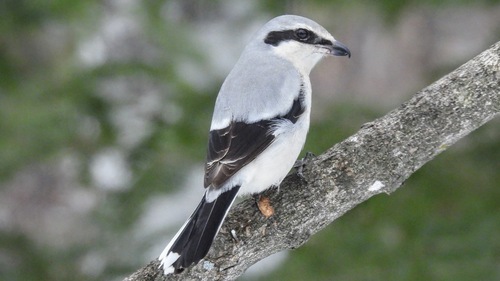
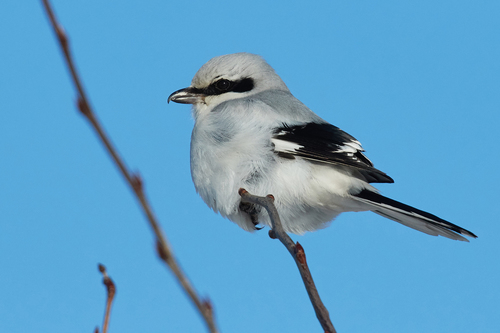
The upperparts are generally pearl grey, with a brownish tinge in populations in the eastern part of the species' Eurasian range. The cheeks, chin, and a thin, often hard-to-see stripe above the eye are white. A thick black mask runs from the beak through the eye to the ear coverts, while the area immediately above the beak is grey. The shoulder feathers (scapulars) are white, and the wings are black with a white bar formed by the bases of the primary flight feathers; in some regions this white bar extends slightly offset onto the bases of the secondary flight feathers. The tail is black, long, and pointed at the tip, with white outer vanes on the outer tail feathers. The underparts are white, with a faint grey tinge in most subspecies. The breast is usually darker and sometimes browner than the rest of the light underside, and may appear as an indistinct band between the lighter belly and white throat. Faint brownish barring may appear on the breast, particularly in North Pacific subspecies and in females from other regions. The bill is large, hooked at the tip, and mostly black, but pale at the base of the lower mandible, with the extent of this pale area varying seasonally. The legs and feet are blackish.
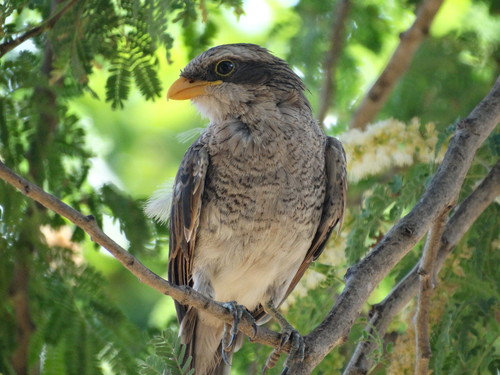
Males and females are the same size, and do not have obvious differences in appearance that are visible without direct comparison. Females have greyer underparts that usually show visible greyish-brown barring, and their white wing and tail markings are characteristically smaller in extent, though this is rarely clearly visible except in flight. Fledged young birds have an overall heavy greyish-brown tinge, with barring on the upperparts and indistinct buffy-white markings. The tips of the tertiary flight feathers and the wing coverts are also buffy, with a black band on the wing coverts. Fledglings of the North American subspecies borealis are distinctly brown on the upperparts and wings, and have bold dark barring on the underparts. In Eurasia, fledglings moult into a female-like plumage in autumn, and usually retain their tertiary barring. Young great grey shrikes gain full adult plumage during their first spring across the entire range of the species.
The species' breeding range generally covers Eurasia and northern Africa. In the high mountains of the Altai-Tian Shan region, its range extends south to approximately 42° north latitude, while its northern limit is generally 70° north latitude. It only occurs as a vagrant in Iceland, the British Isles, the Mediterranean region (excluding the Iberian Peninsula and possibly Romania, but including Cyprus), and Korea. There are no confirmed breeding records for the entire Kamchatka Peninsula. Small populations existed in Switzerland, the present-day Netherlands, and southern Germany in the mid-20th century, but these populations have declined or disappeared entirely since then.
Most great grey shrikes are short-distance migrants, with the exception of the largely year-round resident subspecies bianchii, and subspecies excubitor in temperate European parts of the range with mild maritime climates. Migrations are triggered by food scarcity, so the winter range may extend little south of the breeding range, or be entirely parapatric to it, depending on prey population levels. Populations of Central Asian mountains mostly migrate downslope rather than southwards. Females are more likely to migrate than males, but on average do not migrate longer or shorter distances than males, so females are the dominant sex in many parts of the winter range. Birds travel to winter grounds a short time after breeding, between July and October, with most departing by September, and return to breeding grounds mainly in March or April, though some do not arrive until May. In recent decades, more individuals have been observed staying on breeding grounds year-round, for example in Fennoscandia. In contrast, the subspecies borealis remains just as rare a winter visitor in northern Ohio as it was a century ago.
The preferred habitat is generally open grassland, sometimes with scattered shrubs, and adjacent elevated lookout perches. These perches are normally trees, most often at forest edges across much of the habitat, or single trees or small stands at the taiga-tundra border. In steppe regions, great grey shrikes will use any isolated perch, including fence posts, power lines, or rocks. Generally, the species requires 5–15 perching sites per hectare of habitat. It avoids low grassland with no available lookouts or nesting sites (trees or large shrubs), as well as dense forest with no open hunting ground. Besides grassland, great grey shrikes will also hunt in bogs, forest clearings, or non-industrially farmed fields. Breeding individuals appear to have different microhabitat preferences, but little detailed information about this is currently known.
Great grey shrikes eat small vertebrates and large invertebrates. To hunt, they perch on the topmost branch of a tree, utility pole, or other similar elevated spot in a characteristic upright stance, between 1 and 18 metres above ground. They may also scan the grassland below from flight, staying in roughly the same spot during prolonged hovering bouts that can last up to 20 minutes. They drop down in a light glide to capture terrestrial prey, or swoop like a hawk to catch flying insects. Small birds are sometimes caught in flight too, usually when the shrike approaches from below and behind and seizes the bird's feet with its beak. If no prey comes out into the open, great grey shrikes will rummage through undergrowth, or sit near prey hiding spots and flash their white wing and tail markings to scare small animals into moving into the open. As previously noted, they will sometimes mimic songbirds to lure them within striking distance.
Typically, at least half of the total prey biomass comes from small rodents in the groups Cricetidae (voles, lemmings) and Murinae (Eurasian mice, and occasionally young Eurasian rats). Shrews, songbirds and other passerines, lizards, and frogs and toads (usually tadpoles) make up most of the remaining vertebrate prey. Birds generally make up a small portion of the diet, except in spring when male songbirds are occupied with courtship displays and often unaware of their surroundings, in late summer when inexperienced fledglings are abundant, and in winter when most small mammals hibernate. Occasionally, great grey shrikes eat bats, newts and salamanders, and even fish. Exceptionally, prey may be almost as large as the shrike itself, for example willow ptarmigan (Lagopus lagopus) chicks or young stoats.
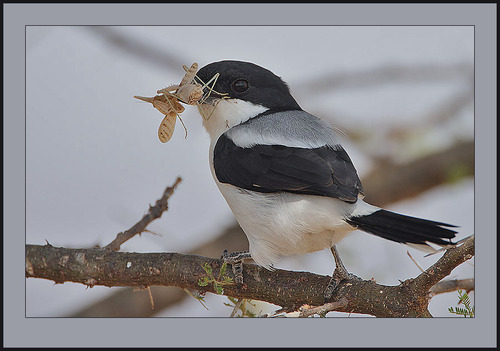
Large arthropods are the second most important prey type by number, though not by biomass; by biomass, they are only slightly more important than birds, but they make up a substantial part of the diet for nestlings. The most important invertebrate prey are insects, especially beetles (including ground beetles, dung beetles, rove beetles, and darkling beetles), crickets and grasshoppers, and bumblebees and wasps. Less important invertebrate prey include spiders and scorpions, crayfish and isopods, snails, and oligochaete worms. Carrion and berries are rarely or never eaten. While the species may occasionally plunder songbird nests, this is not well documented, and great grey shrikes are not known to eat eggs.
Prey is killed by striking it with the hooked beak, targeting the skull for vertebrate prey. If prey is too large to swallow in one or a few chunks, it is transported to a feeding site carried in the beak, or carried in the feet if the prey is too large for the beak. The feet are not suited for tearing prey apart. Instead, the prey is impaled on a sharp point such as a thorn or a barbed wire barb, or wedged tightly between forking branches. Once secured this way, the shrike can rip the prey into bite-sized pieces with its beak. Orthoptera that the shrikes identify as containing noxious chemicals are left impaled in the larder for several days, until the chemicals that deter most predators break down. Great grey shrikes have also been observed to impale common toads (Bufo bufo) and skin them by ripping open the back skin and pulling it over the toad's head, to avoid contaminating the meat with the toad's toxic skin secretions. Large bones and other inedible prey parts are usually not eaten, but smaller inedible parts such as tiny bones or beetle elytra are eaten, and later regurgitated as pellets.
The basic metabolic rate of the great grey shrike is around 800 milliwatts, or slightly more than 11 milliwatts per gram of body mass. An adult great grey shrike needs approximately 50 g (1.8 oz) of prey per day, with requirements likely being somewhat higher in winter. Under most circumstances, this adds up to one or two rodents, one or two additional vertebrate prey items, and a mass of invertebrates equivalent to up to one vertebrate prey item. Surplus prey is impaled for storage. These storage "larders" are typically around 1 m (3.3 ft) above ground, and can be located anywhere within the bird's territory, but they tend to be located closer to nest sites than far away.