About Lanius dorsalis Cabanis, 1878
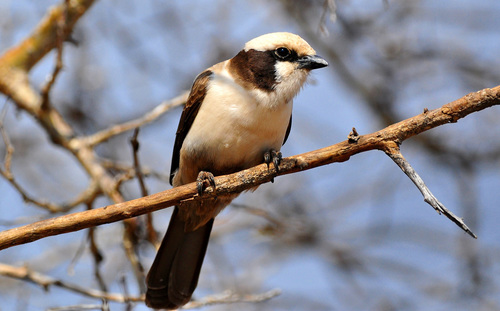
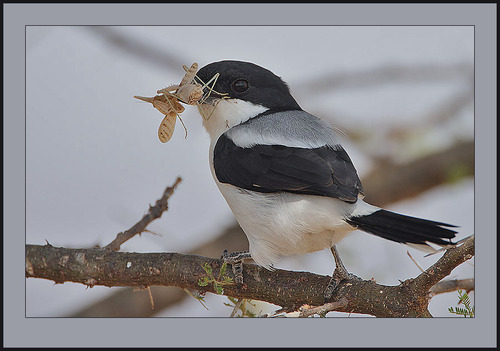
The Taita fiscal, scientifically named Lanius dorsalis Cabanis, 1878, is a fairly distinctive passerine that measures 21 cm (8.3 in) in length. Adults have white underparts, and a black crown, hindneck, and wings. Their back is grey marked with a characteristic white 'V', their rump is white, and their relatively long tail is black with white outer feathers. There is a small white patch on the wings, and the bill, eyes, and legs are all black. Adult males and females have similar plumage, with the only difference being a rufous lower flank on females that is usually hidden by the wing. Juveniles are mainly brown-black on the upperparts, with barring on the head and buff tips on the shoulder feathers; their underparts are whitish with darker barring. When clearly observed, adult Taita fiscals can be distinguished from other black-headed fiscals by their grey back and wing pattern. The species produces a jumbled mix of shrike-like whistles and buzzes, and its song includes the sequence chwaa-pikerrek-chrrrr-yook pikechik. The Taita fiscal has a restricted range in East Africa, where its distribution overlaps with that of the Somali fiscal (Lanius somalicus). It occurs across most of Kenya, being absent only from the coastal strip and the Highlands. It can also be found in southern and western Somalia, southern Ethiopia, southeastern South Sudan, northeastern Uganda, and northern Tanzania. Taita fiscals are usually solitary. They hunt insects and small vertebrates from an exposed perch or the tops of shrubs. They build their nests as cups made of twigs and grass, placed inside thorn trees. A typical clutch contains three or four white eggs blotched with grey.