About Lanius cristatus Linnaeus, 1758
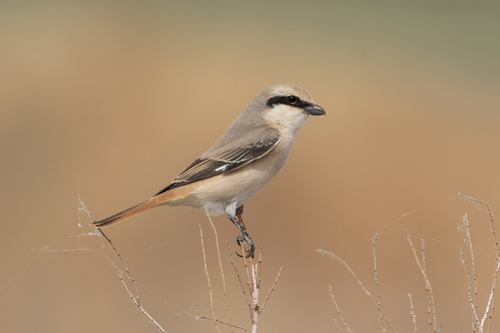
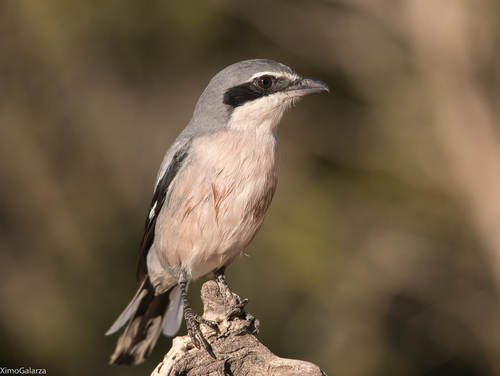
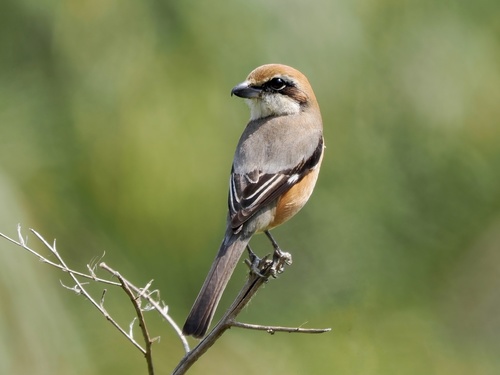
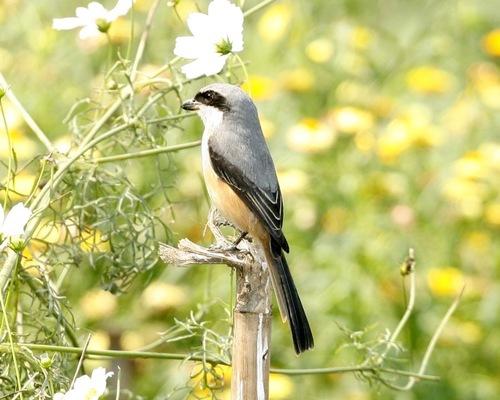
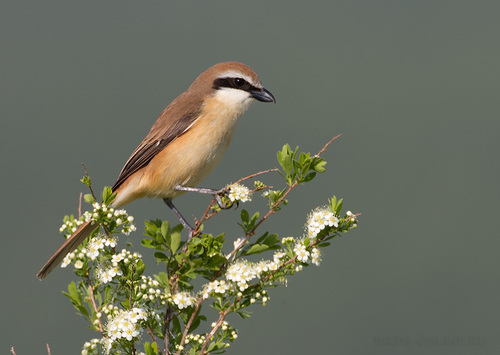
Scientific name: Lanius cristatus Linnaeus, 1758. This shrike has mainly brown upperparts and a rounded tail. It has a black mask that can turn paler in winter, with a white brow stripe above the mask. Its underside is creamy, with rufous flanks and belly. The wings are brown and do not have any white "mirror" patches. Females usually have fine scalloped markings on the underside, and their mask is dark brown and less distinctly marked than the male's. This plumage difference is not easy to use to tell sexes apart in the field, but testing with breeding birds in Japan found females can be identified by the presence of a brood patch. Using multiple body measurements allows correct sex discrimination for about 90% of individuals. Subspecies lucionensis has a grey crown that blends into its brown upperparts, and its rump is more rufous than the rest of its upper back. Its tail is more brownish, and not as reddish as the tail of the red-backed shrike. Young lucionensis birds have a brown crown and no grey coloration on the head. Subspecies superciliosus has a broad white supercilium and a richer reddish crown. Its tail is redder and tipped with white. A number of hard-to-distinguish forms are found in central Asia, where populations of L. cristatus, L. isabellinus and L. collurio overlap. The taxonomy of this group has long been unsettled, and some forms such as phoenicuroides, formerly considered subspecies of L. cristatus, have now been moved to the species L. isabellinus. Subspecies lucionensis has been recorded interbreeding with superciliosus in Ishikawa, Japan, while superciliosus has interbred with Lanius tigrinus in central Japan. The nominate subspecies breeds in northern Asia from Mongolia to Siberia, and winters in South Asia, Myanmar and the Malay Peninsula. The race confusus described from the same region is not distinctly marked, but is said to have a wider white brow and paler upperparts, and is sometimes included within the nominate population. Subspecies superciliosus, sometimes called the Japanese shrike, breeds on the islands of Sakhalin, Kuril and Japan, and winters in Hainan, Sumatra, Java, and the Sunda Islands. Subspecies lucionensis, sometimes known as the Philippine shrike with local names tarat or pakis-kis, breeds in Korea and eastern China, and winters mainly in Taiwan and the Philippines, but also on the Andaman Islands and in peninsular India. Stuart Baker suggested this species may breed in the Cachar Hills of Assam, but this idea was questioned by Claud Buchanan Ticehurst. This species is rare in Europe, and vagrants have been recorded in the United States and Canada. The brown shrike is a migratory species, and ringing studies show they have high fidelity to their wintering sites, often returning to the same locations each winter. They begin establishing wintering territories shortly after arrival, and their loud chattering or rattling calls are distinctive. Birds that arrive early and establish territories appear to have an advantage over birds that arrive later in winter areas. Their migration timing is very regular: they arrive at wintering grounds in India in August and September, and depart in April. During their winter period, they go through a premigratory moult. Their song in winter quarters is faint, somewhat resembles the call of the rosy starling, and often includes mimicry of other birds. The beak stays closed when the bird sings, so only throat pulsations are visible, although the bird moves its tail up and down while singing. The breeding season is late May or June. Breeding habitat ranges from taiga and forest to semi-desert, where they build a nest in a tree or bush and lay two to six eggs. They feed mainly on insects, especially Lepidoptera. Like other shrikes, they impale prey on thorns. Small birds and lizards are also sometimes preyed upon. A white-eye (Zosterops) has been recorded in its prey larder. They typically watch for prey from a perch, then fly down to the ground to capture it.