About Lanius collaris Linnaeus, 1766
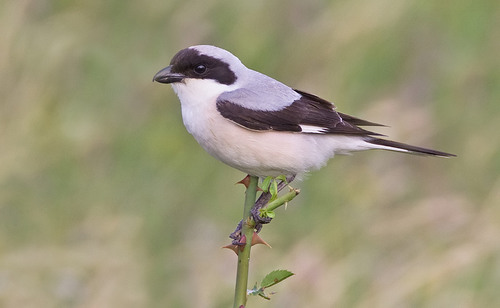
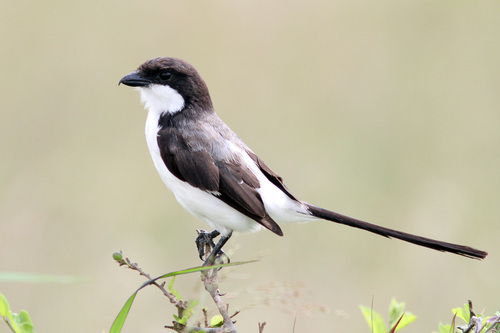
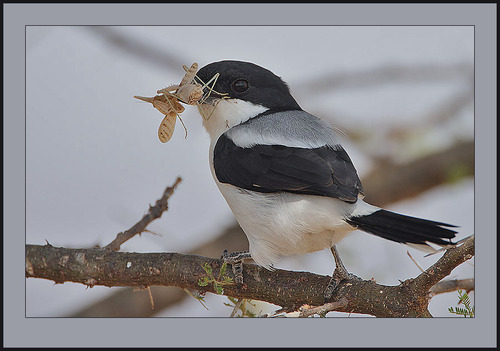
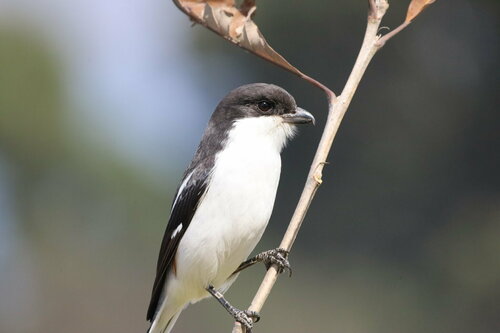
This is a fairly distinctive 21 to 23-centimeter long passerine bird, with white underparts and black upperparts that extend from the top of the head down to the tail. It has a characteristic white "V" marking on its back, and a relatively long black tail with white outer feathers and white tips on the remaining feathers. Its bill, eyes, and legs are all black. Adult male and female common fiscals (also called southern fiscals) are quite similar, with the only difference being the rufous lower flank of females. Its calls are a jumbled mix of shrike-like swizzling sounds that include some imitations, alongside a harsh Dzzzttt-dzzzt-dzzzt alarm call. Most of these calls function as either threatening or alarm calls. The species sometimes produces a surprisingly sweet, quiet song; regardless of how sweet it sounds, this song generally serves either a territorial or pair-bonding purpose. The southern fiscal lives in a wide range of habitats, from grassland with fences for perching to acacia thornveld or even woodland, but it avoids very dense habitats that would impair its hunting. Southern fiscals may be exposed to cold temperatures during winter and in high-altitude environments. To adapt to these cold temperatures, fiscal shrikes go through seasonal changes in body temperature, oxygen consumption, and evaporative water loss to conserve energy. Shrikes at lower altitudes have higher basal metabolic rates, higher evaporative water loss, and higher body temperatures than shrikes that live in higher altitude environments. During winter, the basal metabolic rate and oxygen consumption of southern fiscals increase, while their body temperature decreases.