About Lanius bucephalus Temminck & Schlegel, 1845
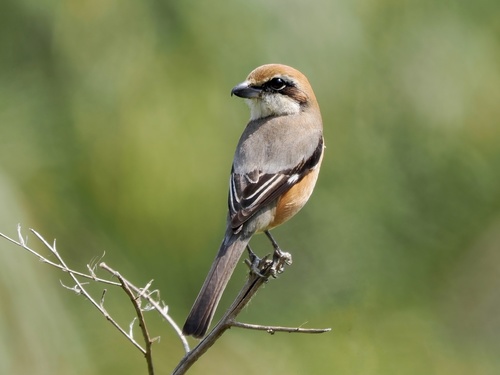
The bull-headed shrike, scientifically named Lanius bucephalus, is a passerine bird in the shrike family Laniidae native to eastern Asia. It measures approximately 19–20 cm, or 7.48–7.9 inches, in length. The male bull-headed shrike has a brown crown, a white eyebrow stripe, and a black mask. Its back is grey-brown, its wings are dark with a distinct white patch, its flanks are rufous, and the remainder of its underparts are whitish with fine barring. Females are similar in overall appearance but are duller and browner, have a brown mask, and lack the white wing patch. This species produces harsh grating and chattering calls, and can also mimic the calls of other birds. It breeds in northeast China, Korea, Japan, and far-eastern Russia, specifically Ussuriland, Sakhalin, and the Kuril Islands. Northern populations migrate south for the winter, with a small number reaching southern China. Vagrants have been recorded in Taiwan, Hong Kong, and Vietnam. An isolated subspecies, L. bucephalus sicarius, occurs only in the mountains of Gansu Province in west-central China. Bull-headed shrikes prefer open habitats including farmland and woodland edges, and will also visit urban parks and gardens. They sit on prominent perches to wait for passing prey. Their diet consists mainly of insects such as beetles and crickets, but they also prey on lizards and crustaceans. Like some other species in the genus Lanius, such as the great grey shrike Lanius excubitor, bull-headed shrikes are known to impale their prey on sharp points, most commonly thorns. This behavior makes it easier to rip prey into bite-sized pieces, and may also be used to cache food or mark territory boundaries. The bull-headed shrike builds its nest in bushes or bamboo. Clutches contain two to six eggs, which are incubated for 14 to 15 days. Young birds fledge 14 days after hatching.