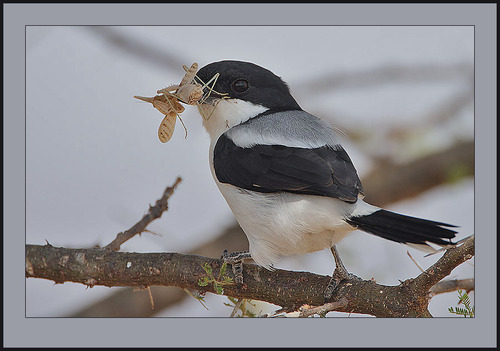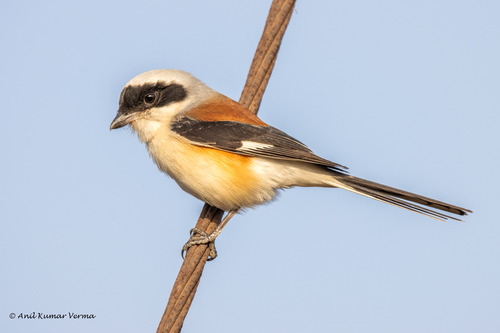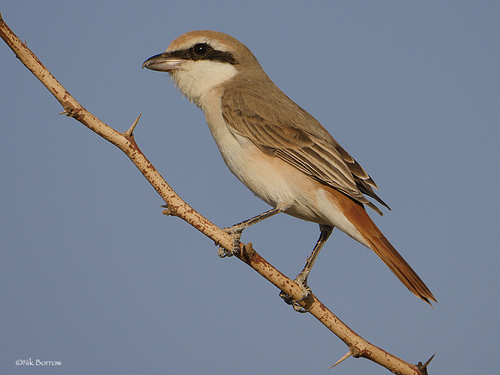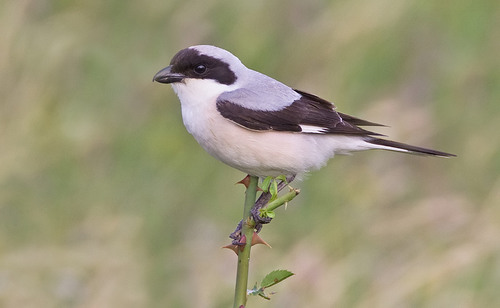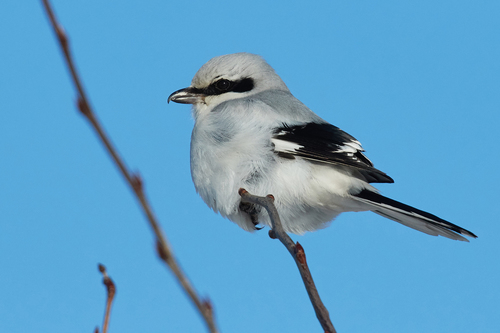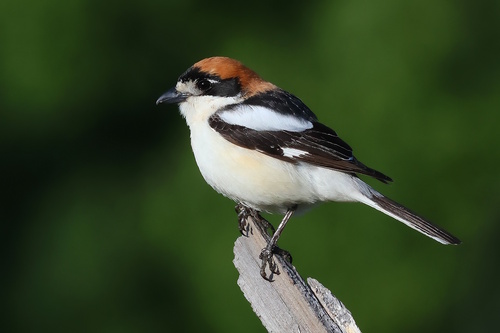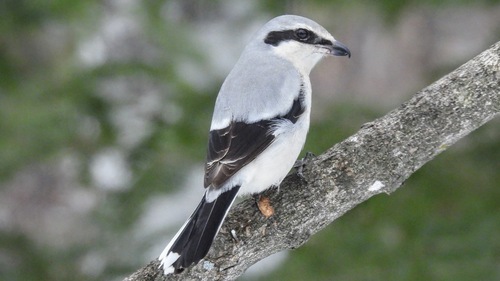
About Lanius borealis Vieillot, 1808
This description compares the loggerhead shrike to the northern shrike (Lanius borealis Vieillot, 1808). The loggerhead shrike can be told apart from the northern shrike by its smaller body size, darker grey plumage, and larger black face mask that fully covers the eye. It also has a shorter bill with a less prominent hook. The calls of the two species are similar. Measured body dimensions for this group are: length 9.1–9.4 in (23–24 cm), weight 2.0–2.8 oz (57–79 g), and wingspan 11.8–13.8 in (30–35 cm).
The northern shrike breeds in taiga and tundra, ranging from Labrador west through Alaska (including some Aleutian Islands) to western Siberia, and south to extreme northwestern China, northern Mongolia, and James Bay. It breeds in forest edge habitats where suitable trees or shrubs are available, and has been recorded nesting in white spruce, black spruce, felt-leaf willow, mountain alders, and poplars. The northern edge of its breeding range is bounded by the presence of 1-2 meter high shrubby willows.
Northern shrikes are irruptive during the non-breeding season. Some individuals remain in the breeding range year-round, but most move south based on winter severity, food supply, and competition from other shrikes. In winter, they can reach as far south as northeastern China and Japan in Asia; in North America, they irregularly reach as far south as New Mexico, Kansas, Illinois, Ohio, Pennsylvania, and New Jersey. On wintering grounds, northern shrikes prefer open country, including forest edges, prairies, agricultural land, savannas, and coastal marshes. Observations of wintering habitats in Idaho suggest suitable wintering territories are in high demand, as dead northern shrikes in a given area are quickly replaced.