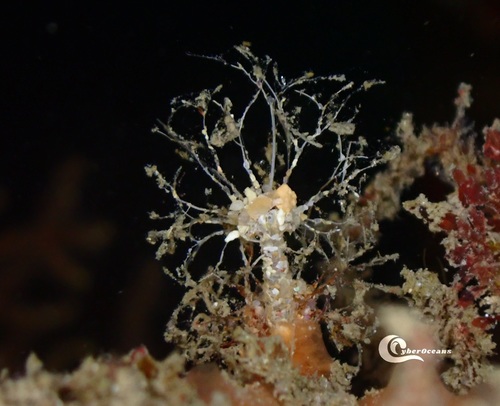
About Lanice conchilega (Pallas, 1766)
Lanice conchilega can reach up to 30 centimetres in length and have as many as 300 body segments. It has an elongated body split into two distinct regions. Its head features a dense tuft of long, thin tentacles. The narrow upper lip surrounds the mouth. The buccal segment has protruding lobes on its lateral and ventral sides, and it carries many eye spots. Segments 2 through 4 bear branching gills that have broad stems and thick crowns. The third segment has a large lobe that covers the second segment. Posterior to these gill-bearing segments, the cylindrical, firm thoracic region is made up of 17 segments. Glandular pads are present on the ventral sides of segments 14 through 20; these segments hold both hair-like and hooked chaetae. The long, slender abdomen is soft and only bears hooked chaetae. The body of this worm is yellowish, pink, or brown, with pale tentacles and red gills. This species occurs across many regions of the northern hemisphere. It inhabits soft sediments including sand and muddy sand, and can also be found among Zostera seagrass and benthic algae. It tolerates low salinity, and occurs in the eulittoral zone down to depths of 1700 metres. Large groups of this mason worm can act as reef-builders. Their tube patches alter local habitat structure, and affect the distribution and abundance of other species that live within the seabed. From July to September, its larvae make up as much as 15% of total zooplankton biomass. Lanice conchilega is a common food source for several species of wading birds and young flat fish.

