About Laniarius major (Hartlaub, 1848)
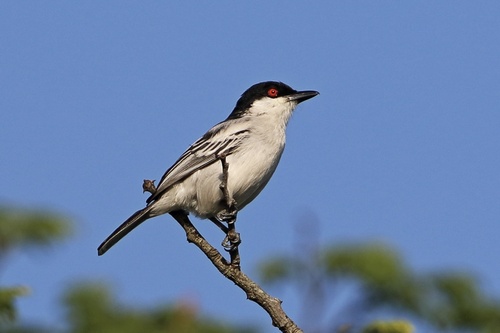
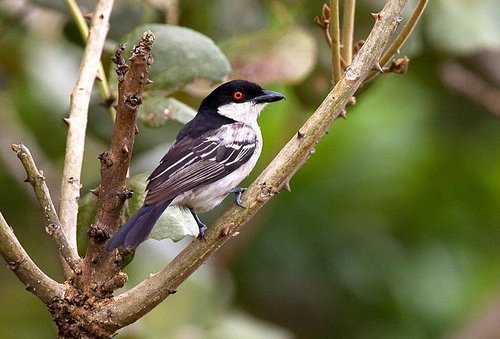
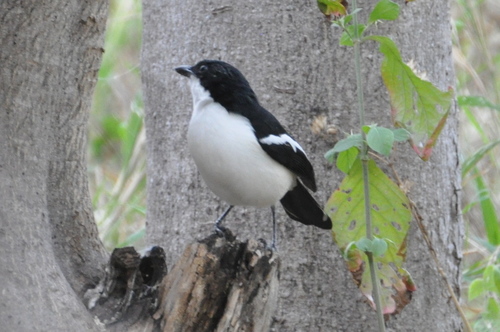
Laniarius major (Hartlaub, 1848), commonly called the tropical boubou, is a fairly large bushshrike. Adults measure 23–25 cm in length, with a weight ranging from roughly 38 to 70 g; most adults weigh between 50 and 60 g. On average, females are slightly smaller than males, but individual size variation is so large that the sexes appear identical in size for most practical purposes. Average wing length is 98 mm, with a range of 85 to 110 mm; average tail length is just 2 mm longer than the wing, and follows the same size range. Tarsus length is 29–37 mm, averaging 33 mm. Exposed culmen length measures a little over 20 mm in some populations and up to 25 mm in others; unlike other measurements which vary primarily between individuals, bill length can differ distinctly between subspecies. Males and females have identical size, and also identical plumage. Adult upper parts and tail are glossy blue-black, apart from concealed white spots on the rump that are only visible when the wings are spread and rump feathers are erected. Underparts are white; in some populations, the breast and flanks have a buffy or pinkish tinge, which is not always noticeable except in good light. Most subspecies have a white stripe on the wing coverts, which in some extends onto the secondary remiges. Some subspecies have white tips on the outer tail feathers. The bill is black, legs and feet are bluish grey, and irides are dark reddish brown. After hatching, nestlings are nude with pinkish-brown skin, and later grow sparse down; they have spots inside their bills that they show to parents to solicit feeding. Fledglings resemble adults but have duller plumage: their brownish head and upper parts appear mottled from yellowish-ochre to tawny feather tips, which form barring on the lower back and rump. Any existing wing-stripe is dulled. Undertail coverts are buff, and the dull white underside usually has dusky barring, especially on the flanks. The bill is greyish brown above and paler below. Immature birds that are independent of their parents have lost most of their mottling (except on wing coverts) and barring, but their wing stripe and underside remain dull white, shading to brown on the flanks; white tail feather tips first appear at this stage. The northwesternmost populations of L. major may be confused with Turati's boubou (L. turatii), which lacks a white wing-band and has a buff chin and white belly. L. major found around the southern edge of the Congo Basin look almost identical to the swamp boubou (L. bicolor), but L. bicolor has pure white underparts, and females of this species produce a characteristic 'ratchet' call during duets. Southeastern populations (subspecies mossambicus, and especially limpopoensis) resemble the southern boubou (L. ferrugineus), but are black above rather than dark brown and grey – this difference can be hard to see at distance, and completely indistinguishable in occasional hybrids. When the tropical boubou lives sympatrically with other Laniarius species, it rarely occupies the same habitat. The tropical boubou occurs from approximately 10° northern latitude south to the Limpopo River in South Africa. In the western part of its range, it is a regular breeding bird from Côte d'Ivoire eastwards to about 5° N. It does not occur further south along the Atlantic coast or in the inner Congo Basin, but it is found on the Scarp of Angola. It also does not appear to occur in northern Somalia, eastern Ethiopia and Kenya, central Tanzania, or the lower Ruvuma River basin. It is not migratory and only moves locally, though seasonal movements have been recorded in Kenya. Vagrants have been recorded from Senegal, and records from The Gambia and Liberia are also probably mostly or entirely stray birds; a supposed vagrant record from Bioko is no longer believed to be this species. It is not found in distinctly arid regions or dense forests such as equatorial rain forest, but does occur on mountains up to 3,000 m above sea level. It requires dense ground cover, and occurs in a variety of forest and forest-edge habitats, including savannah, Miombo woodland and village gardens. In the drier parts of its range, it is generally restricted to riparian forest, though the black boubou (sometimes split from this species) also uses semiarid shrubland. Typical vegetation in its habitat includes African juniper (Juniperus procera), bracken (Pteridium), Rosoideae shrubs, and Brachystegia. Tropical boubous defend a breeding territory of 1–3 hectares; outside the breeding season they move across a larger area (up to 8 hectares) and are more tolerant of other members of their species, sometimes gathering into loose noisy groups. They rarely fly long distances, and tend to skulk in shrubs and low in trees like a coucal (Centropus), or move on the ground, pausing occasionally to stand alert and watch with the tail slightly raised. When alarmed, they make a slow descending flight, flashing their white rump patches and giving warning calls, before taking cover. As is typical for passerine birds, they scratch indirectly (foot-over-wing). Allopreening between mated pairs has been recorded. At least southern populations molt their entire plumage after the breeding season. This species is presumably preyed on by the common vertebrate predators of mid-sized birds. A ringed individual was recorded at nine to ten years of age. The tropical boubou may be locally common, reaching densities of 100 individuals per square kilometer; in other areas, densities are only one third of this. It is not an uncommon bird across its breeding range, so the IUCN treats it as a species of least concern. If the species is split into multiple taxa, the black boubou and dimorphic boubou (which have limited ranges) may warrant reclassification to a higher risk category. This species is monogamous. Like many tropical birds, it does not have a strongly pronounced breeding season. Near the Equator, breeding can occur at any time of year. Further north and south, there is a peak breeding season in late spring and early summer at the start of the wet season, with little to no breeding occurring in late autumn and early winter at the start of the dry season. Courtship begins with the male chasing the female; the two hop together through branches, and the male bobs its head, bows, and gives a croaking call or low whistle. The male performs gliding or descending display flights with white rump spots exposed, and produces mechanical noises with its remiges. Courtship climaxes with the male holding his wings drooped, tail fanned, and rump feathers puffed up, while giving repeated metallic or whistling calls. Breeding pairs may duet, but courtship feeding has not been observed. Both parents build the flimsy cup nest, though the female does more of the work. The nest is made of twigs, tendrils, small roots, and occasional grass leaves or bark pieces, bound together with spider web, and sometimes lined with finer fibers. The walls are thick – from 1 cm to more than 5 cm – but loosely constructed, so the eggs can often be seen through the outside of the nest. The nest is 10 to 20 cm in diameter, with a shallow inner cup around 8 cm in diameter and 2–5 cm deep. It can be placed at varying heights: from a few dozen centimeters above ground in a thicket to more than a dozen meters up in a tree top, but it is typically built around 3 meters high, in a bush, on a horizontal branch fork, or in vines. Nesting sites are often solitary bushes, which provide cover while letting the incubating bird observe the surrounding area for threats. The female lays three, and sometimes two, eggs. The eggs are bluish to buff green with brown and lilac spots, and measure around 22–27 by 17–19 mm, averaging 25 by 18.3 mm. Both parents incubate, but the female does most of the work. Eggs hatch after 14–16 days, and nestlings take the same amount of time to fledge. Parents usually destroy the nest after the young leave it. They continue to feed their offspring for approximately seven more weeks, after which the young can forage on their own. Young stay with their parents for about five months. The black cuckoo (Cuculus clamosus) is a common brood parasite of the tropical boubou, parasitizing around 2 percent of its nests. When tropical boubous detect black cuckoos, they usually attempt to mob them away and are often successful; some pairs, however, are very ineffective at preventing brood parasitism and may be affected multiple times per year. The tropical boubou usually forages on or near the ground, and does not often ascend to the tree canopy. It holds large prey down with its foot while eating. Like other bushshrikes (and true shrikes, Laniidae), the tropical boubou impales prey on thorns to eat later; it also wedges prey into crevices. Its diet includes many types of large terrestrial invertebrates and their larvae, as well as small terrestrial vertebrates, including amphibians, beetles, geckos, lizards, Lepidoptera (moths and butterflies), mantises, Orthoptera (crickets, grasshoppers and locusts), rodents, snakes and termites. It often plunders other birds' nests, and occasionally eats snails and fruit.