About Laniarius funebris (Hartlaub, 1863)
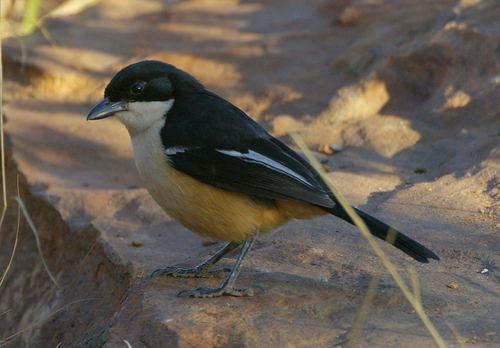
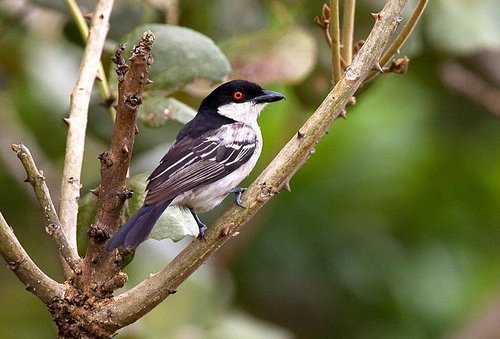
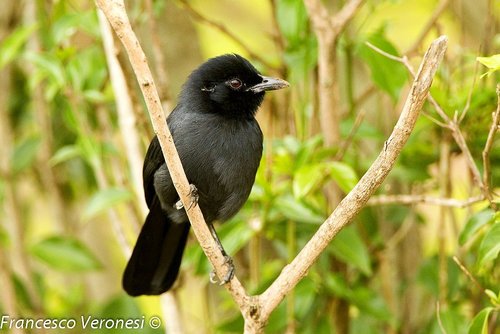
The slate-colored boubou, also spelled slate-coloured boubou, is a species of bird in the family Malaconotidae, with the scientific name Laniarius funebris. It is found in Ethiopia, Kenya, Rwanda, Somalia, South Sudan, Tanzania, and Uganda. Its natural habitats are subtropical or tropical dry forests, dry savanna, subtropical or tropical dry shrubland, and subtropical or tropical moist shrubland. German naturalist Gustav Hartlaub described this species in 1863. Two subspecies, funebris and degener, are currently recognized. The position of Laniarius funebris within the genus Laniarius is unclear, but it does not appear to be closely related to black-plumaged members of the genus such as Fuelleborn's boubou, Laniarius fuelleborni. Some authorities had previously considered the slate-colored boubou and Fuelleborn's boubou to be the same species. Adult slate-colored bous are 20 cm (8 in) long and have entirely dark slate grey plumage. Males and females are very similar in appearance. Immature birds have plumage that is more heavily barred with tawny brown and black. The male's call repertoire includes a noisy shhhhh, a strong clicking sound, and a coco-weet call with a rising inflection on the final syllable. Calls vary regionally across the species' range. Songs are frequently sung as a duet between the male and female of a mated pair. A 1983 study observed four distinct types of songs sung by males during these duets. Researchers concluded that one song type is used for mating, two are used to mark territory, and the fourth type may function to prevent the male's mate from singing alone, a behavior that could attract other males. The frequency at which males sing territorial songs varies with the level of threat from other bous and the level of cooperation between mated partners. A 1992 study of the species' calls found that a male's likelihood of singing a mating song correlates with his mate's estradiol levels, rather than his own testosterone levels. This finding suggests that behavioral cues between mated pairs, rather than individual hormone levels, are the most important factor in triggering mating songs. The slate-colored boubou builds its nest in a shrub or tree around 1.5 m (5 ft) above the ground, and lays a clutch of 2–3 eggs per nesting attempt.