About Langermannia pachyderma (Peck) Kreisel
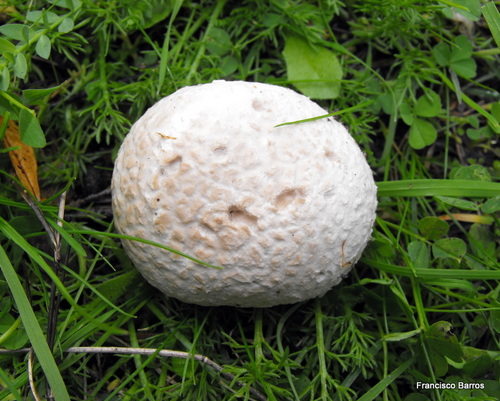
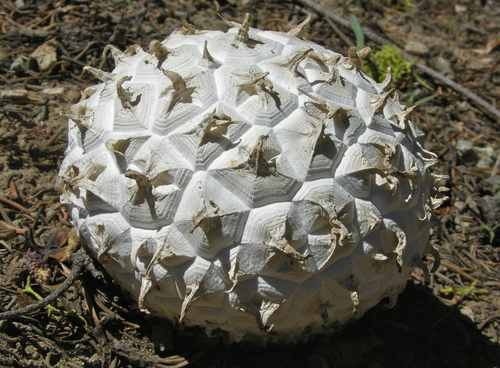
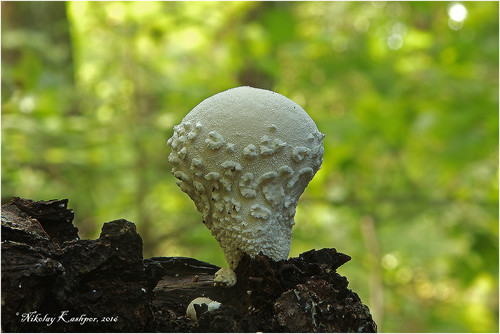
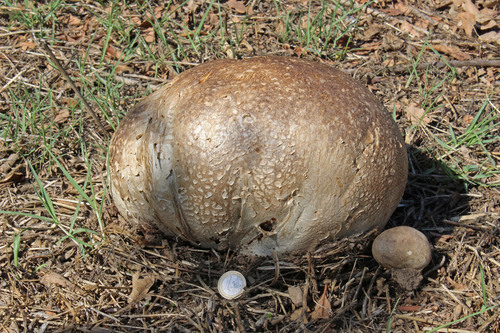
In 1882, Peck originally described this species (then classified within Lycoperdon) as: subglobose, measuring four to six inches in diameter, with a somewhat pointed radicating base. Its external peridium is thin, smooth, and whitish, with the upper portion cracking into small, angular, persistent spot-like scales or areas. The inner peridium is thick, subcorky, and somewhat brittle, and its upper part eventually breaks apart into irregular fragments. The capillitium and spores are ochraceous-brown; capillitium filaments are long, flexuous, and somewhat branched, measuring 0.0003 of an inch, while spores are subglobose or broadly elliptical, measuring 0.0002 to 0.00025 of an inch long. The type specimen was collected in Arizona in June by Pringle. Peck noted this was a distinct species of Lycoperdon in the section Bovistoides, with unusually thick peridium. It also appears to lack a cellular base, a trait that brings it closer to the genus Bovista, but the characteristics of its capillitium threads place it correctly in Lycoperdon. Kreisel notes that most Calvatia species grow in dry or mesophilic grassland, arctic-alpine meadows, or semi-desertic vegetation, with some growing in gardens and cultivated soils; only a small number of species occur in forests and other shady locations. American mycologist David Arora states this species (often called Calvatia pachyderma) is most often found in open, cultivated, and arid places. This thick-skinned puffball is primarily a spring mushroom in the Northern Hemisphere, but can also be found at the start of the rainy season in fall. It may grow singly or in small groups, and sometimes forms fairy rings. This puffball, or its very closely related nearly indistinguishable similar species, often grows in or near grass, and/or along compacted trails. In California, Calvatia pachyderma is locally and/or seasonally common along the coast and at lower elevations of the Sierra Nevada mountain range. In Arizona, it is found at mid to higher elevations in Great Basin conifer woodland and Madrean evergreen woodland habitats. In western North America, Calvatia pachyderma may be confused with Calvatia booniana or Calvatia craniiformis. The outer skin of C. booniana breaks into polygonal or irregular-shaped patches, while C. pachyderma often develops vertical longitudinal cracks at the apical portions of the gasterocarp, then pulls away from the gleba in fairly large plates. C. craniiformis is usually smaller than C. pachyderma, and has a thin, delicate outer skin. Mycenastrum corium also shares some similar features, but mature Mycenastrum corium spores are red-brown or dark-brown, while C. pachyderma spores are yellow-brown or olive-brown. Controversial putative populations of this species (with some papers claiming they are the same species and others disputing this) have been recorded at high altitudes of Iran and Nepal, as well as in South Africa, Russia, Bulgaria, Turkmenistan, Chile, and other locations.