About Langaha madagascariensis Bonaterre, 1790
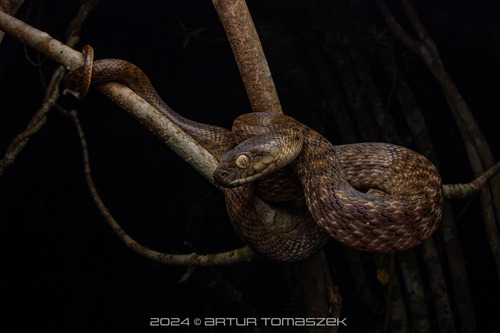
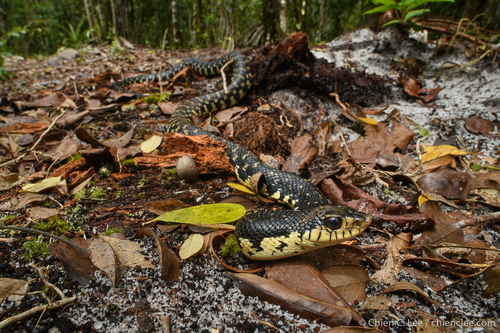
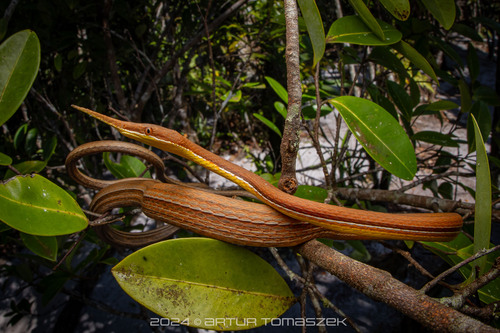
Langaha madagascariensis, commonly known as the Malagasy leaf-nosed snake, can reach a maximum length of 1 meter. This species displays unusually high levels of sexual dimorphism. Males are brown on their dorsal side and yellow on their ventral side, with a long tapering snout, while females are mottled grey with a flattened, leaf-shaped snout. The function of this distinctive snout appendage is not confirmed, though it is known to provide the snake with camouflage. Malagasy leaf-nosed snakes have unusually slender bodies, and can be easily identified by their long, pointed snouts. This species is primarily a sit-and-wait predator. Its main diet consists of frogs and lizards, including both arboreal and terrestrial lizards. While stalking prey, L. madagascariensis performs a hooding behavior. It may also rest in a curious distinctive posture, hanging straight down from a branch. Researchers hypothesize that its hooding and swaying behaviors, combined with its cryptic color patterns, may let the snake mimic a vine swaying in wind. Malagasy leaf-nosed snakes are oviparous, and their clutch sizes range from 5 to 11 eggs. In general, these snakes are calm, and they are reluctant to bite unless they are provoked.