About Lampyris noctiluca (Linnaeus, 1758)
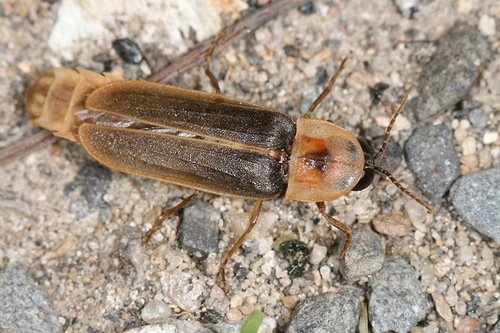
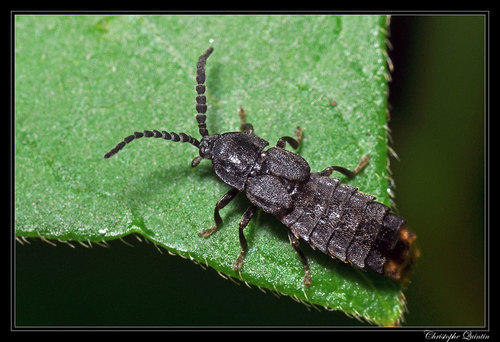
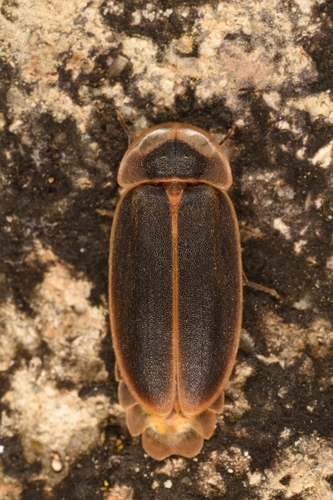
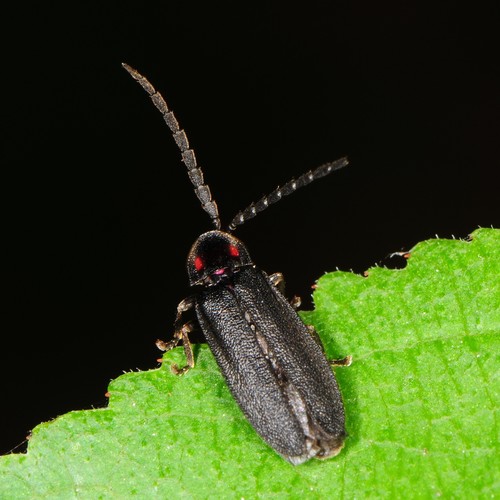
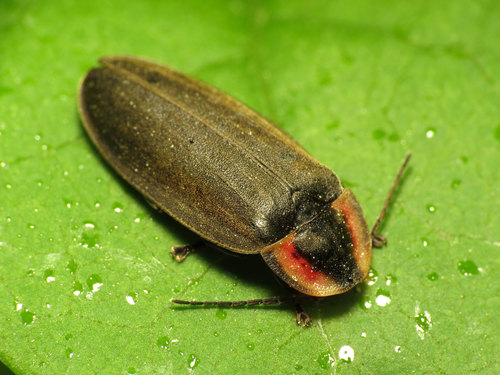
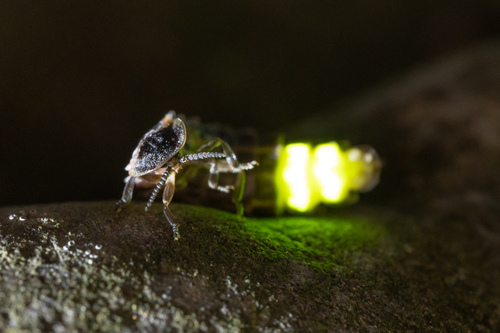
This species, the common glow-worm, has the scientific name Lampyris noctiluca (Linnaeus, 1758). Adult females range from 12 to 20 mm in length, while males are significantly smaller. Newly hatched larvae are only a few millimeters long. All individuals have segmented bodies, ranging in color from brownish to blackish, and are soft-bodied and elongated, with a head concealed by a pronotum and threadlike antennae. Males have two pairs of wings: the second pair is used for flight, while the first hardened pair (called elytra) covers the flying wings. Females cannot fly. Bioluminescence is restricted to the last few abdominal segments. Adult females are the most luminous, using their glow to attract males; larvae also glow, but their light is faint and intermittent. The light produced is an efficient cold light: only about 3 percent of the species' chemical energy is wasted as heat, which is more efficient than many other glowing species. While larvae share segmented bodies and six near-head legs with adults, their movement makes them resemble caterpillars.
The range of this beetle extends from Portugal and Great Britain in the west, across Europe, Africa, and Asia, to China in the east. Reports of this species from Ireland are unverified, with no records in the Irish Biodiversity Database. It lives further north than any other firefly, reaching almost to the Arctic Circle. It is not found in North America, South America, South Asia, Australia, or Antarctica. Within the UK, it is found mainly in valleys in Wales and Scotland, and it also occurs in other European locations including Estonia, Belgium, and Finland. It typically favors chalky and limestone areas, open grassland, hedges, and woodland, and is rarely found on land improved for agricultural use. It prefers open air, which helps females attract males via their light displays during June, July, and August. More specifically, its habitat includes old-growth grassland, especially on chalk and limestone soils, as well as road verges, hedgebanks, and heaths. Larvae occupy sheltered spots under rocks and wood, but will crawl across different terrain.
In reproduction, females play the key role of attracting mates. To attract flying males that fly roughly one meter above the ground, females climb plant stalks. By positioning themselves above most ground-level vegetation and bending their abdomens upward, they display their glowing organs to signal passing males. A female's entire adult life only lasts a few weeks, which are entirely dedicated to glowing, mating, and laying eggs before she dies. Eggs hatch after a few weeks, and the larval stage lasts one or two, or sometimes up to three, summers. During this stage, larvae feed on small snails and slugs by paralyzing prey before consuming it. This long development cycle contributes to the species' characteristic "boom or bust" population cycles, where abundance fluctuates greatly between years. A unique biological feature of this species is its hormone-influenced sex determination, which is rare among insects. Sexual differentiation between males and females begins during the fourth larval instar, with initially subtle distinctions. At this stage, male cells in the apical tissue of the gonads begin to divide, while female cells divide in the basal gonad tissue. Transplanting testes into females before the fifth instar causes masculinisation, while the same procedure done later, or attempts to feminise males, does not result in sex reversal. This confirms that testes can transform pre-fifth instar female gonads into male gonads, but ovaries do not have a feminizing effect on males.
The full life cycle starts when a glowing female attracts a male to mate. After mating, the female lays 50 to 100 eggs over three days in moist locations such as under moss, under leaf litter, or on grass stems, then dies before her eggs hatch. The pale yellow eggs are each around 1 mm in diameter, and may emit a faint yellow glow. They hatch within two to three weeks, and hatching may take longer in colder climates. Upon hatching, larvae resemble adult females but can be distinguished by bright spots on each of their 12 segments; adult females have completely black backs. Larvae go through a two to three year predatory feeding phase. They primarily hunt slugs and snails, which are often up to 200 times the larva's own weight. They inject prey with a toxic brown digestive fluid through a series of nips and bites; this method avoids the larva getting stuck in the prey's protective mucus, and gradually turns the prey's internal tissues into a digestible broth that the larva can consume. Even partially eaten prey may still crawl away after the larva finishes feeding. Larvae are nocturnal, and are most active during moist conditions when their prey is also active. Throughout the larval stage, they molt four to five times. During winter, when food is scarce, they hibernate under logs, stones, or leaf litter, with their bodies drawn in. They awaken in spring to continue development. The transition to adulthood takes place between May and July, or sometimes later. Adults do not feed, and survive only on the food reserves they accumulated during the larval stage. After reaching maturity and reproducing, both males and females die, completing the cycle. Adults typically live no longer than two to three weeks. All feeding occurs during the larval stage: larvae are active predators that roam leaf litter to find slugs and snails, inject digestive enzymes to liquefy the prey's internal contents, then consume the softened tissue. Adults completely lack mouthparts, so they cannot feed at all.