About Lampsilis fasciola Rafinesque, 1820
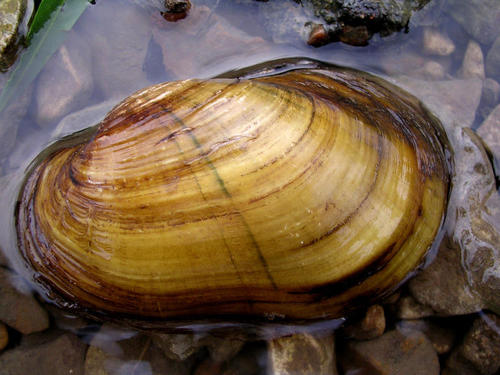
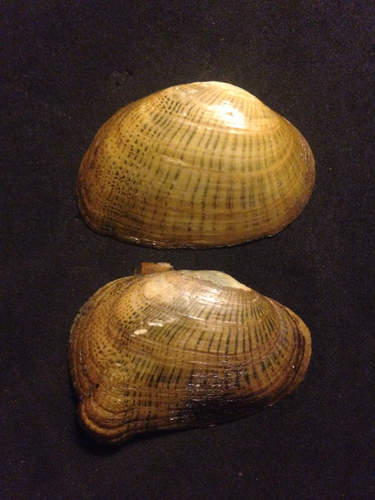
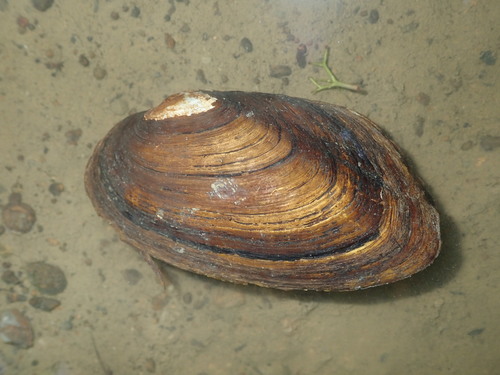
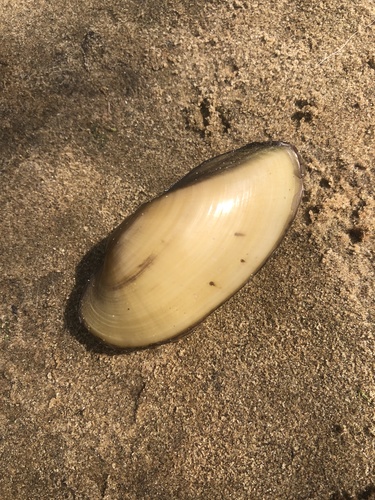
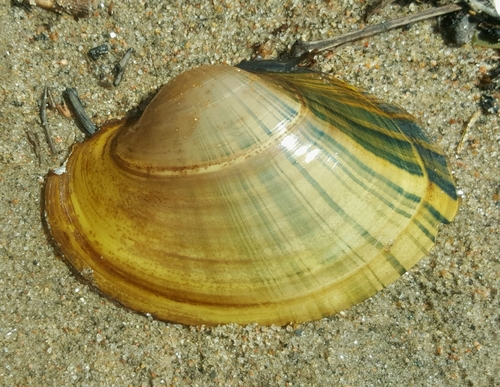
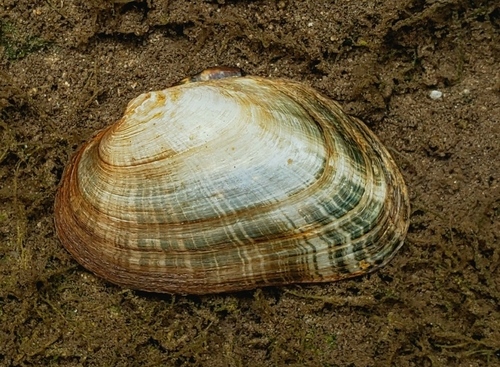
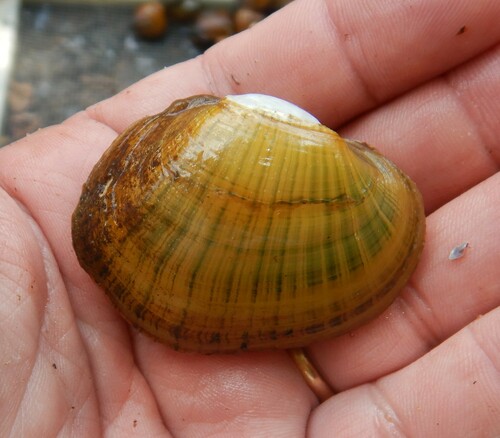
Lampsilis fasciola Rafinesque, 1820, commonly called the wavy-rayed lampmussel, is a relatively small mussel native to Southern Ontario, Canada and northeastern sections of the United States. Its shell is yellow to yellowish-green, and it gets its common name from the many thin wavy rays that cover its shell. These wavy rays can be thin and separate, or they can join together into much wider rays. The beak is slightly raised above the hinge lines, and the beak sculpture is made up of 3 to 5 wavy lines. The shell shape ranges from compressed to inflated, with females being more inflated. The anterior end of the shell is rounded; the posterior end is bluntly pointed in males and rounded in females. The nacre of the mussel is usually white or bluish, and the overall shell shape is rounded and generally symmetrical along its axis. The shell is mostly smooth, though it may have occasional wrinkles and growth rests. Most wavy-rayed lampmussels are less than 75 millimetres (3.0 in) long, but some individuals can reach 90 to 100 millimetres (3.5 to 3.9 in) in length.
Historically, wavy-rayed lampmussels are distributed across Southern Ontario and 13 U.S. states, including the Ohio watershed. In Ontario, the species has been confirmed in at least four river watersheds: the Ausable, Grand, Maitland, and Thames. This mussel lives on gravel and sand bottoms in medium-sized streams, and it is particularly sensitive to environmental changes. It is typically found in streams with steady good currents, near riffles, and it is rarely found in medium-sized rivers. Like many mussel species, the larvae of Lampsilis fasciola are parasitic; they attach themselves to fish hosts and get nutrients from the fish's body until they develop into juvenile mussels, then drop off. The known fish hosts for wavy-rayed lampmussel larvae are largemouth bass and smallmouth bass. These fish hosts are especially important for maintaining healthy wavy-rayed lampmussel populations.