About Lamprotornis superbus Rüppell, 1845
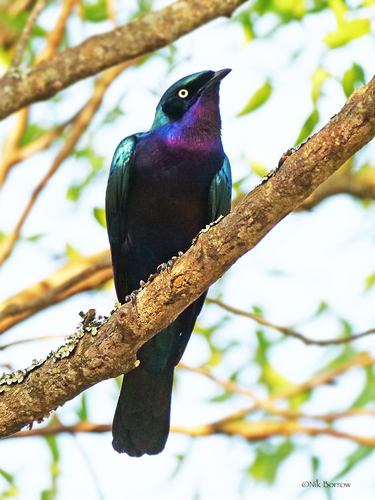
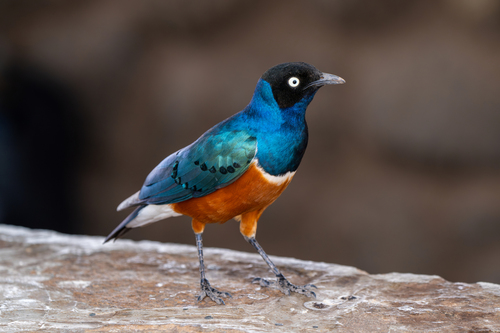
Lamprotornis superbus Rüppell, 1845, commonly called the superb starling, measures 18 to 19 cm (7.1 to 7.5 in) in length. These small, short-tailed starlings have a long narrow bill, robust bodies, strong feet, and a distinctive plumage pattern. Their striking iridescent plumage comes from the arrangement of melanin granules within the feathers, which produces structural blue and green colors, rather than colors obtained from pigments. The superb starling looks very similar to Hildebrandt's starling, which also lives in East Africa. The superb starling can be distinguished by its pale creamy-white eyes, while Hildebrandt's starlings have red eyes. In addition, only adult superb starlings have a white breast band.
The superb starling inhabits savanna, thornbush and acacia arid areas, open woodland, lakeshore woodlands, gardens, and cultivated fields, at elevations ranging from 0 to 2,650 metres (0 to 8,694 ft) above sea level. They tend to avoid humid lowland areas. This species has a very large range and is commonly found in East Africa, including Somalia, Uganda, Kenya, South Sudan, Ethiopia, and Tanzania. Superb starlings typically occupy large territories, often larger than 50 hectares (0.50 km2). When they are not on their territories, they are usually foraging for food or traveling to water sources. Their social groups can contain more than 40 individuals, with an approximately equal sex ratio. During the non-breeding dry season, superb starling groups live alongside other starling species, including Hildebrandt's starling (Lamprotornis hildebrandti) and the greater blue-eared glossy starling (Lamprotornis chalybaeus). They have also been observed with other bird species, including the red-billed buffalo weaver (Bubalornis niger) and the white-headed buffalo weaver (Dinemellia dinemellii), in Tanzania's Serengeti National Park. Mixed-species flocks may help with foraging and act as a defense against predators. During the breeding season, however, superb starlings are territorial and will chase birds of other species away from their group, especially when the other birds approach their nests.
The breeding season runs from October to February in Ethiopia, and from March to June in Somalia. Superb starlings have been observed running on the ground and jumping with drooping wings and outstretched heads, a behavior thought to be a form of nuptial display.