About Lamprotornis mevesii (Wahlberg, 1856)
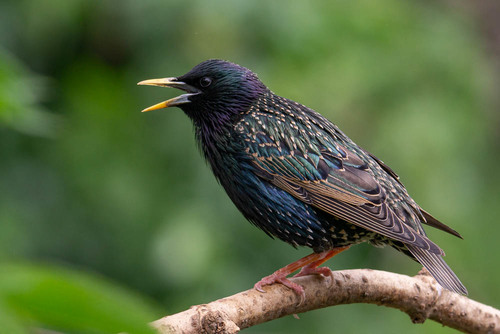
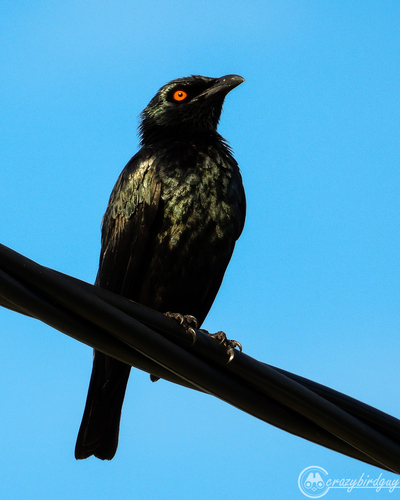
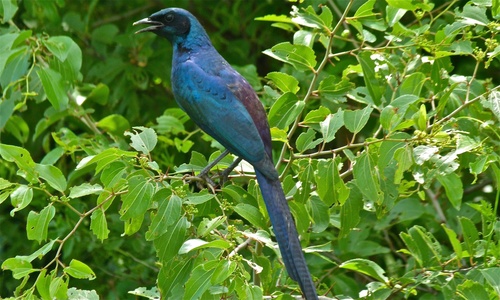
Meves's starling, with the scientific name Lamprotornis mevesii (Wahlberg, 1856), is also known as Meves's glossy starling and long-tailed starling. It is a species of starling belonging to the genus Lamprotornis. This species can be found in Angola, Botswana, Malawi, Mozambique, Namibia, South Africa, Zambia, and Zimbabwe. Both its English common name and scientific Latin name honor the German ornithologist Friedrich Wilhelm Meves. Meves's starling measures 30–36 cm in total length, and has a very long tail. In dull light, it appears black; in bright light, it shows a moderate to intensely strong iridescent gloss. It can be told apart from the similar Burchell's starling by its longer tail with strongly graduated feathers, where the central pair of tail feathers is the longest, and each subsequent outward pair of feathers is shorter than the one before it. It can also be distinguished from other long-tailed species in the genus Lamprotornis by its dark eyes. Three subspecies of Meves's starling are currently accepted. The first is Lamprotornis mevesii benguelensis Shelley, 1906, which occurs in southwestern Angola, on the Angola Escarpment, and is duller, browner, and less glossy on its body and tail than the other subspecies. The second is Lamprotornis mevesii violacior Clancey, 1973, found in northern Namibia and south-central Angola, which has a dark violet-purple gloss. The third is the nominate subspecies Lamprotornis mevesii mevesii (Wahlberg, 1856), distributed from southeasternmost Angola and northeastern Namibia's Caprivi Strip through Botswana, east to southeastern Zambia, southern Malawi, and northeastern South Africa, which has an intense green-and-blue gloss, with some bronze gloss on its flanks. While some authorities have recognized these three taxa as separate species, this classification is not widely followed. Meves's starling typically occurs in small flocks in mopane woodland, most often along major river basins, and is frequently found in areas that flood during the rainy season. Its breeding season runs from September to May, with peak nesting activity occurring between February and March.