About Lamprotornis hildebrandti (Cabanis, 1878)
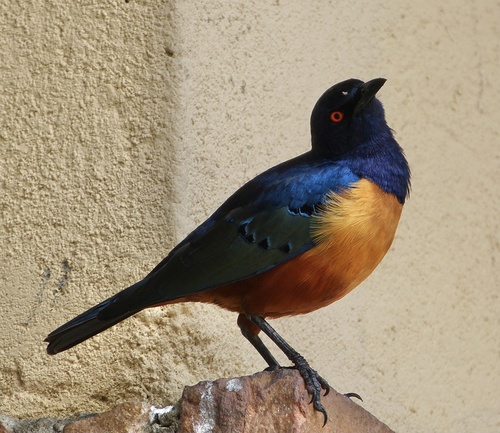
Hildebrandt's starling, scientifically named Lamprotornis hildebrandti (Cabanis, 1878), measures 18 cm (7.1 in) in length and weighs 50 to 69 g (1.8–2.4 oz). Adult individuals have bright iridescent plumage on their upper body and upper surfaces. Like its close relatives, this iridescence comes from light interference caused by ordered microscopic feather structures, rather than from pigments. The head and most of the upperparts are blue; the wings are bronze-green with blue primary feathers; the throat and upper breast are glossy purple; and the tail is glossy blue-green. The mid-breast and upper belly are orange-buff, while the lower belly is rufous. The iris is orange-red, and the bill and legs are black. Adult males and females have identical external appearance, and the species can be confused with the superb starling. Juveniles look quite different, with charcoal grey upperparts and chestnut brown lowerparts. Hildebrandt's starling produces a variety of calls and songs. Its song is a slow low sequence: "ch-rak ch-rak chee-chee-wee chee-wee rak rak rak". It also has an alarm call of "chu-ee" and a contact call of "chule". This species is found in Kenya and Tanzania, where it lives in open landscapes at elevations between 500 and 2,200 m (1,600 and 7,200 ft). Its preferred habitats are open woodland and open thornbrush country. It is often described as uncommon, but its abundance ranges from fairly common to fairly uncommon across its range. The IUCN does not consider the species threatened, and it is listed as Least Concern. Its habitat is not threatened, and it occurs in multiple protected areas.