About Lamproptera meges (Zincken, 1831)
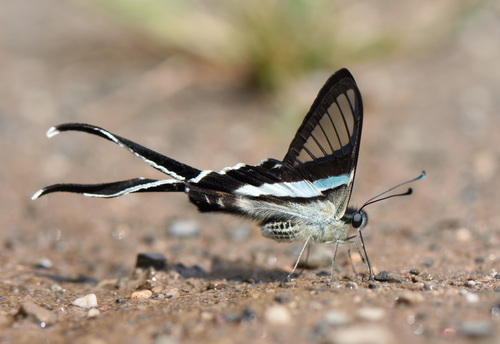
Lamproptera meges, commonly called the green dragontail, is a small butterfly with a wingspan ranging from 40 to 55 millimetres (1.6 to 2.2 inches). Its basic coloration is black and white, and it has a very large white-tipped tail that measures 25 to 40 millimetres (0.98 to 1.57 inches) long. The forewing features a triangular glass-like (hyaline) patch with black borders, plus thin black stripes along the veins that form six to eight spots or bands. It also has a pale band that runs obliquely across the pre-discal area, and this band continues onto the black hindwing, which bears the long tail and a prominent abdominal wing fold. The pale bands of this species are light green, while the pale bands of its close relative Lamproptera curius are white; L. curius also has a hyaline outer edge on its white band. The sexes of Lamproptera meges share the same appearance, but females are duller in color and have a ventral copulation groove before the tip of the abdomen. Males of this species do not have the distinct sex mark (scent organ) that is present in L. curius.
This butterfly is distributed across northeastern India, specifically in the states of Assam, Arunachal Pradesh, Manipur and Nagaland. It can also be found in Myanmar, Thailand, Laos, Vietnam, southern China including Hainan, Cambodia, peninsular and eastern Malaysia, the Indonesian archipelago, Brunei, and the Philippines. Within Indonesia, it occurs on the islands of Sulawesi, Kalimantan, Nias, Bangka and Java. A 2006 report recorded this species from Zhangjiajie in Hunan Province, China.
The life cycle of Lamproptera meges begins with pale green, spherical, smooth eggs that are nearly transparent, and resemble the eggs of other swallowtail butterflies. The caterpillar is dark green with black spots. The chrysalis attaches to the upper surface of a leaf via its cremaster. The primary recorded food plant for this species is Illigera burmanica King, which belongs to the family Hernandiaceae. In the Philippines, the butterfly has also been recorded feeding on Zanthoxylum species from the family Rutaceae.