About Lampropholis delicata (De Vis, 1888)
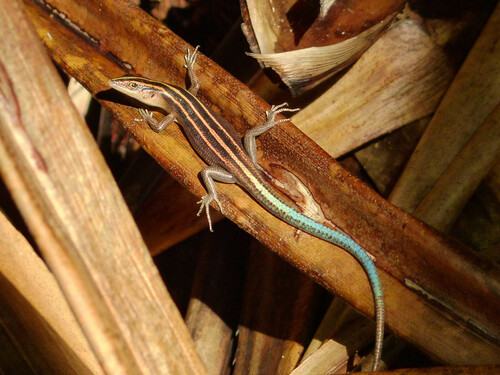
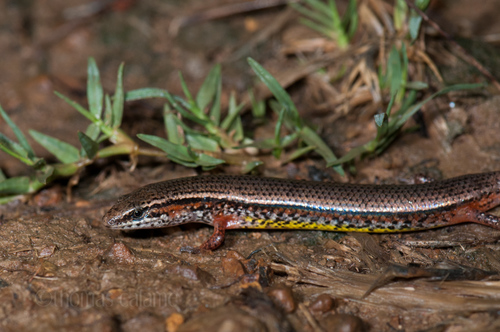
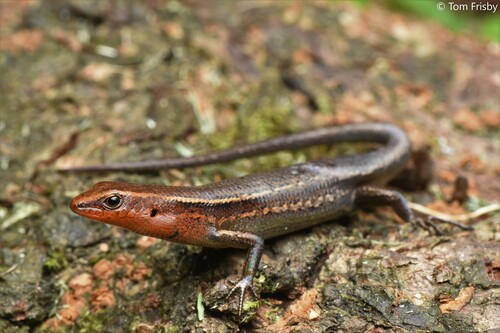
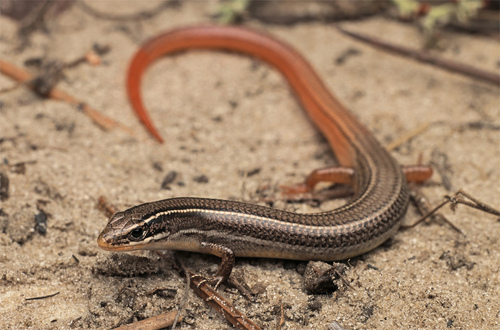
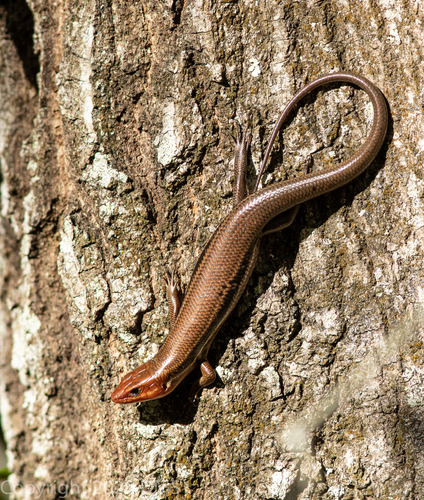
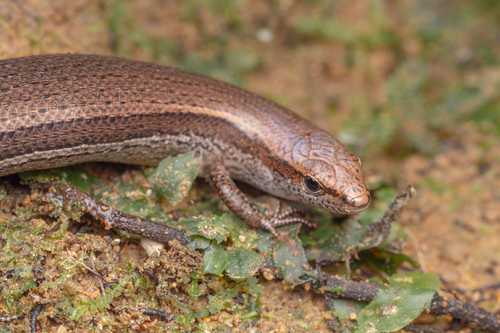
Lampropholis delicata, commonly called the delicate skink, is more abundant in suburban gardens than in nearby native bushland. It has a moderate-sized body, a medium-length slender tail, and smooth scales. Its back and sides range from greyish-brown to rich brown, and often have both darker and paler flecks. A narrow yellowish-brown stripe is usually present along the outer edge of the back. This species has two distinct forms based on the prominence of a white stripe, and this dimorphism is not strictly separated by gender. Sexual dimorphism is also present in L. delicata: males have broader, longer heads, while females have larger abdomens and overall body sizes. The delicate skink is native to Eastern Australia and belongs to the skink subfamily Lygosominae. It was accidentally introduced to the remote oceanic Lord Howe Island, located between Australia and New Zealand, in the 1980s, and was later introduced to the Hawaiian Islands. After introduction, these lizards spread rapidly across the islands. On Lord Howe Island specifically, they live in low-elevation vegetation communities. The species is also invasive in New Zealand, Hawaii, and Lord Howe Island. L. delicata is a diurnal species with seasonal variation in activity, peaking between November and December. Tail loss and subsequent regeneration occurs frequently in these lizards, and is most often observed in females and adults. While the biological mechanisms of the reproductive cycle differ between male and female L. delicata, their cycles align seasonally to allow mating in late summer. Mating has only been observed in late summer, even though males have a second period of available sperm. In males, testes contain very few mature sperm during late autumn and winter. During this period, spermatogonia are the dominant germ cells, and seminiferous tubules are at their smallest diameter. Spermatogenesis begins in early spring, allowing development of primary and secondary spermatocytes. By the end of September, mature sperm fill the now-expanded seminiferous tubules, and sperm are depleted through October and November. A second wave of spermatogenesis occurs in summer, producing more mature sperm by February, which are then depleted from the seminiferous tubules, first in spring and again in autumn, presumably for mating. In females, ovaries are quiescent between February and July (autumn and winter). Follicles begin growing to notable sizes between August and October (late winter and spring). In October or November, one to two follicles per ovary become vitellogenic and are ovulated. After ovulation, the corpus luteum forms and persists until oviposition, which occurs roughly one month later. Following ovulation, many other growing follicles become vitellogenic, but they may not ovulate and can regress after the late summer mating period. All these ovarian events correspond to changes in ovarian weight. While young adult females rarely have growing oocytes, young adult males of all ages undergo spermatogenesis. Most L. delicata produce no more than one clutch per season, but some evidence indicates young females may produce a clutch in the season after they are born, which matches males' ability to mate in both spring and late summer. Although temperature and photoperiod have been hypothesized to trigger reproductive activity in these lizards, more evidence points to rainfall patterns influencing their reproductive cycles. When annual rainfall, annual vegetation productivity, and arthropod availability are low, food becomes scarce for the lizards. This scarcity can influence follicular development in females, particularly the vitellogenesis cycle, but lower rainfall does not appear to be enough to change male testicular patterns. Female reproduction occurs between September and February, spanning spring to late summer. There is a positive correlation between female body size and clutch size. Clutch size most commonly varies between 1 and 7 eggs, with an average clutch size of 2 to 4 eggs (mean 3.4). Communal egg nests are common, and can hold anywhere from 11 to over 200 eggs. A single clutch per year of around two to four eggs is typical for the species.