About Lampropeltis splendida (Baird & Girard, 1853)
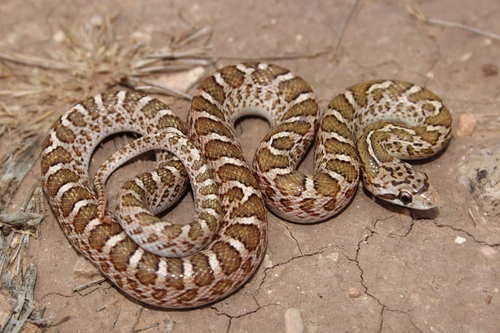
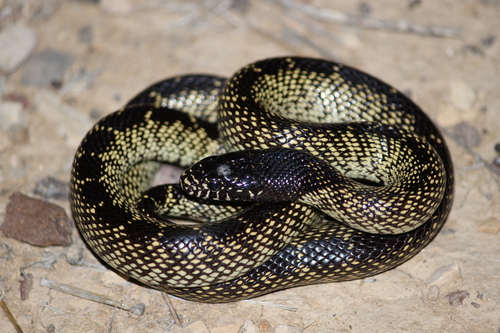
The desert kingsnake, scientifically named Lampropeltis splendida, is a non-venomous kingsnake species native to Texas, Arizona, and New Mexico in the United States. Its body is colored yellow and black. This snake feeds on rodents, lizards, and smaller snakes, including rattlesnakes. Adults typically reach 3 to 4 feet in length, though individuals have been recorded growing up to 6.8 feet long. When encountering humans, desert kingsnakes are docile. If they do not attempt to escape, they often play dead by flipping onto their backs and remaining motionless. Some people such as ranchers keep domesticated desert kingsnakes, hoping the snakes will eat other more threatening snake species. This species was previously classified as a subspecies of the common kingsnake, and is part of Colubridae, the largest snake family in the world. Within its native range, the desert kingsnake can live in any rural habitat. Despite its common name, it is most often found in mesic areas, particularly close to water tanks or within riparian corridors. Like most reptiles, Lampropeltis splendida reproduces by laying eggs. Courtship and mating take place between March and June. Females lay clutches of 5 to 12 eggs with adhesive surfaces in late June or July, sometimes burying the eggs as deep as one foot. This burial helps prevent the eggs from drying out, as their shells are permeable to moisture. After approximately 60 days of incubation, 8- to 10-inch-long hatchlings emerge, each weighing around one-fifth of an ounce. Hatchlings have bright yellow speckles arranged in vertebral cross-lines, and also have a lateral row of large dark brown spots. As the young snakes mature, the dark spots are gradually broken up by spreading yellow flecks.