About Lampropeltis nigra (Yarrow, 1882)
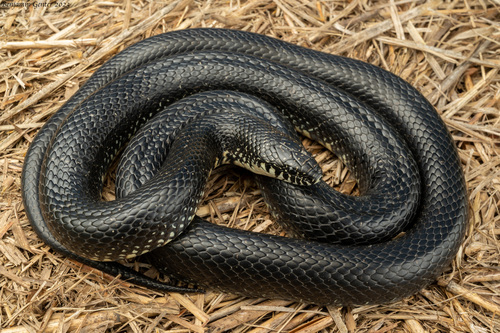
Lampropeltis nigra, commonly called the black kingsnake, is a medium to large constrictor snake. Adults reach an average total length of 90 to 122 centimetres (35 to 48 inches), with maximum total lengths of 147 to 183 centimetres (58 to 72 inches) recorded in some individuals. It is generally similar in form to Lampropeltis getula getula, but can be told apart by both its geographic distribution and visual appearance. Its body is primarily black, with scattered, widely spaced yellow or cream speckles; these speckles are larger and more numerous along the sides of the body. The dorsal surface may be unpatterned in some individuals, and crossbanded in others. The ventral surface has a checked pattern of black and yellow or cream. The number of ventral scales ranges from 197 to 222 across both sexes. Subcaudal scales number from 45 to 59 in males, and 37 to 51 in females. Under different lighting conditions, the ventral scales can show a rainbow-like iridescent sheen. Some individuals have white spots on their bellies, and not all individuals have fully black ventral areas. Black kingsnakes are ophiophagous, meaning they eat other snakes, and they are immune to the venom of some snake species. The black kingsnake is native to the southeastern quarter of the United States. Its range extends from southern Illinois to Ohio, then south along the Appalachian Mountain foothills and the Alabama River watershed to the northern Gulf Coast in southern Alabama, and continues along the coast to the Mississippi River in Louisiana. Black kingsnakes can live in a wide variety of habitats, and they are one of the snake species most frequently encountered by humans in some U.S. states. Their preferred habitats include abandoned farmsteads, debris piles, floodplain edges, and thick brush surrounding streams and swamps.