About Lampropeltis elapsoides (Holbrook, 1838)
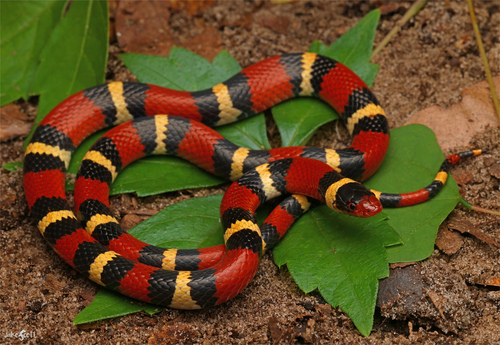
Scarlet kingsnakes (Lampropeltis elapsoides) have a tricolored banded pattern in black, red, white, and various shades of yellow. This pattern mimics the venomous coral snake through Batesian mimicry, which works because predators cannot tell that the mimicry is imperfect. Many popular mnemonic phrases exist to help people tell venomous and non-venomous tricolor North American snakes apart, and they are usually variations of rhymes like "Red touches black, friend of jack, red touches yellow, kill a fellow", "red on yellow, kill a fellow; red on black, venom lack", or "if red touches yellow, you're a dead fellow; if red touches black, you're all right, Jack". For tricolor snakes found east of the Mississippi River, all these phrases can be replaced with the simple saying "Red face, I'm safe". This refers to the red snout of scarlet kingsnakes, which contrasts with the prominent black snout of the eastern coral snake (Micrurus fulvius).
Scarlet kingsnakes are born with white, black, and red banding. As they mature, they develop varying shades of yellow in geographic regions where this trait is expressed. The yellowing is not uniform: pigmentation becomes darker moving from the lowest scales up to the dorsum, or back, creating multiple yellowish bands. Yellowing can start as early as 3 months of age and continues through the first 3 years of life. As adult snakes age, the yellowish bands gradually darken. Yellow pigment can range from lemon yellow to school-bus yellow, tangerine, and apricot.
Scarlet kingsnakes are secretive, nocturnal, fossorial snakes, so they are rarely seen by people. They are excellent climbers. They often hide underneath loose bark on rotting pines, a favored spot in spring or during heavy rain. They can also be found under bark on dying or decaying pines and their stumps, and in decaying wood. In these locations, they hunt their preferred prey: small snakes and lizards, especially skinks. Hatchling scarlet kingsnakes have a strong preference for ground skinks (Scincella lateralis), and will often avoid other prey items to hunt this species. One study found that elongate squamates made up around 97% of these snakes' diet, which may be due to their small mouths. Out of these elongate squamates, ground skinks made up 74%, while colubroid snakes made up only 15%. All prey items consumed in the study were eaten headfirst, and prey averaged 19% of the predator's body mass. Researchers have also noted that the diet of Lampropeltis elapsoides is unusually narrow compared to the diet of adults of most other snake species.
The scarlet kingsnake uses a polygynandrous mating system, meaning both males and females mate with multiple partners. Mating occurs from late May to early June, and females lay eggs in June and July. Females produce multiple clutches of eggs that incubate for 40 to 65 days. Lampropeltis elapsoides is an oviparous snake species, laying clutches of 4 to 12 eggs, most often under rotting wood or between rocks and logs. The eggs are white and slender, and most stick to one another. Eggs typically hatch within 2 to 2.5 months, though hatching time may vary.