About Lampropeltis annulata Kennicott, 1860
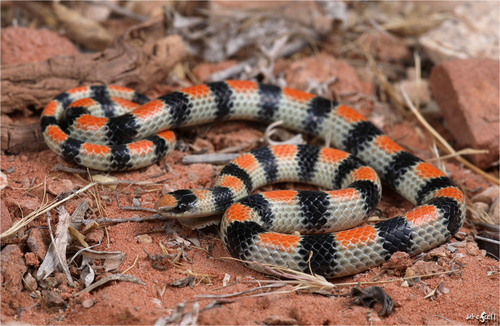
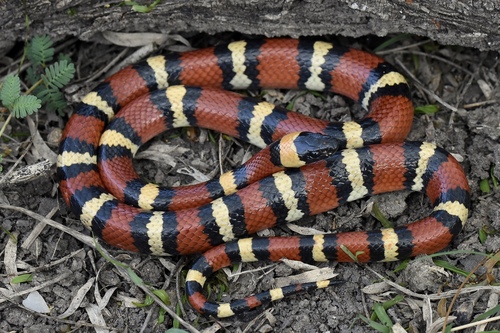
The Mexican milksnake, Lampropeltis annulata, has distinct red, black, and cream or yellow banding that wraps completely around its body. This color pattern is likely an evolutionary survival adaptation: it mimics the venomous coral snake of the family Elapidae, which shares much of the Mexican milksnake's habitat. Because of this mimicry, the species is sometimes referred to as a coral snake mimic. Populations from different regions show consistent color variation: western localities have whiter, brighter cream light bands, eastern and northern localities have duller, dirtier cream light bands, and populations further south often have yellow or orange light bands. The underside of the Mexican milksnake is checkered black and white, matching the pattern of its upper body banding. Southern populations have higher concentrations of black on the underside, while northern populations have more white. This taxon can be distinguished from other milksnakes by the darker color of its light bands. At its lightest, the first light band after the black head is creamy yellow, which is darker than the equivalent band in other milksnake subspecies, and the rest of the light bands across the body are solid cream. At its darkest, the first light band adjacent to the black head is bright yellow or orange-yellow, and the remaining light bands are a lighter shade of yellow, cream-yellow, or orange-yellow. While individual milksnakes from other subspecies can sometimes have darker light bands, this trait is far more common in the Mexican milksnake, which also has other unique distinguishing features. Mexican milksnake light bands are typically noticeably larger than its black bands. The light bands widen from the dorsal scales along the back toward the lower sides and ventral scales on the belly. All populations of Mexican milksnake have especially dark, sharply defined red bands compared to other milksnake subspecies. The red bands are around two to three times as wide as the black bands, and they extend from the sides of the body all the way to the edge of the ventral scales. Mexican milksnakes are shorter in total length but thicker in body girth than other milksnake subspecies. Adults reach approximately 24 to 30 inches (61 to 76 cm) in length, and have more overall girth than related taxa. Unlike the coral snake it mimics, the Mexican milksnake is not venomous. The two species can also be distinguished by band arrangement: in coral snakes, red and yellow bands sit adjacent to one another, while in Mexican milksnakes, red and black bands are adjacent. This species is native to dry, semi-arid regions of northeastern and north-central Mexico, where it occurs predominantly in the states of Coahuila, Tamaulipas, and Nuevo León. Its range can extend as far south as Guanajuato, Hidalgo, San Luis Potosí, and Querétaro, and as far east as the coast of Veracruz. It can also be found as far north as southwestern Texas in the United States, where it has been observed near cities as far north as Kerrville, Ozona, San Angelo, and San Antonio, among other locations.