About Lampornis sybillae (Salvin & Godman, 1892)
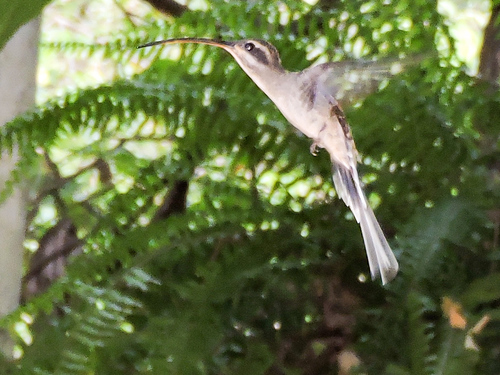
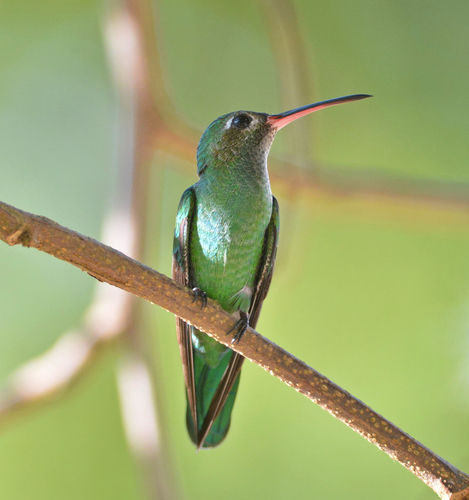
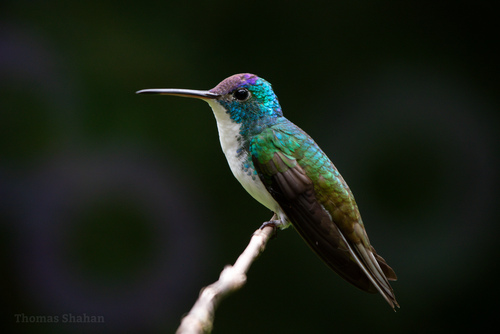
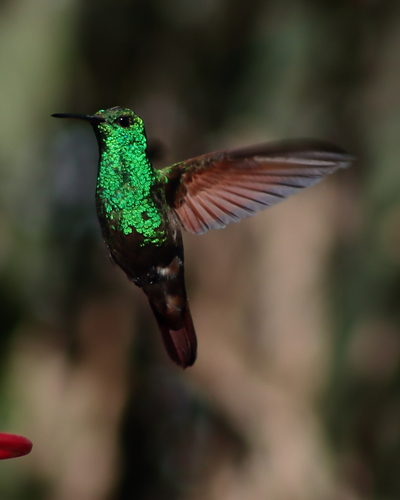
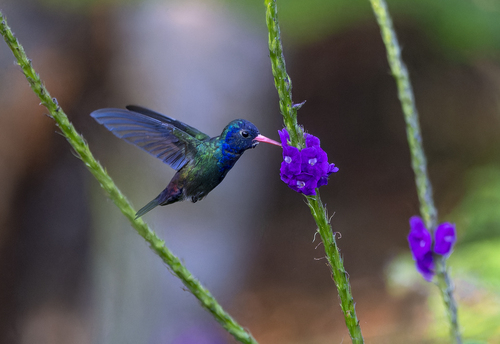
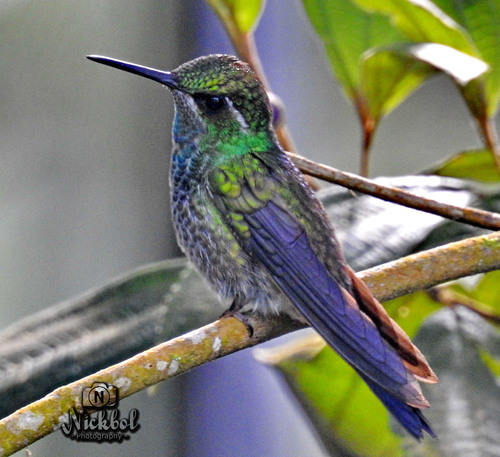
The green-breasted mountaingem (scientific name Lampornis sybillae (Salvin & Godman, 1892)) is about 10 to 11 cm (3.9 to 4.3 in) long and weighs about 4 to 7 g (0.14 to 0.25 oz), with males being larger than females. It has a medium-length straight black bill. Adult individuals of both sexes have deep metallic grass green upperparts, with some bronze coloring on the rump and black uppertail coverts. Both sexes also have a white stripe that curves down behind the eye, and deep metallic grass green cheeks with a thin white stripe below the cheeks. The underparts of adult males are also mostly metallic grass green, with white or grayish white margins on the feathers. The lower belly, vent area, and leg tufts of adult males are white. Their inner undertail coverts are green with white edges, and the outer undertail coverts are dusky gray with wide white edges. Adult males' central tail feathers are grayish black, and the other tail feathers are pale gray to grayish white with dusky margins. Adult females have a buff chin and throat, and grayish white underparts with metallic green on the sides of the breast. The outermost two pairs of the female's tail feathers are white or grayish white with a dusky gray bar near the end, and neither pair has the dusky margins seen on males. Some female individuals have a green sheen on the upperside of the central tail feathers, a feature that males never have. Juvenile green-breasted mountaingems have dark green mottling on their throat and buffy to cinnamon tips on the feathers of the upperparts. Older immature birds begin to develop the adult throat and tail coloration. The green-breasted mountaingem is distributed in central and eastern Honduras and northwestern Nicaragua. It inhabits the interior and edges of humid evergreen forest and pine-oak forest, and also occurs in the transition zone between pine-oak forest and cloudforest. Its elevation range is generally between 1,400 and 2,200 m (4,600 and 7,200 ft), though some authors extend this range to between 750 and 2,400 m (2,500 and 7,900 ft).