About Lampona cylindrata (L.Koch, 1866)
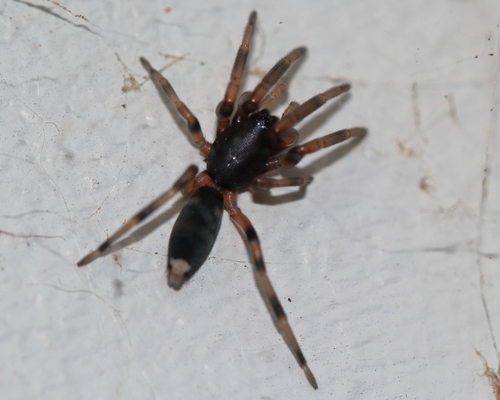
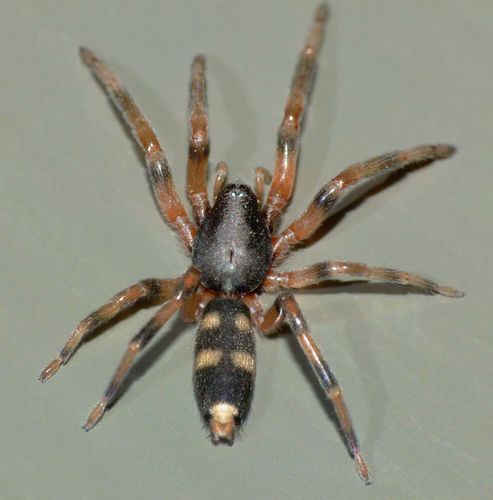
There are two common species of white-tailed spiders: Lampona cylindrata and Lampona murina. The two species are very similar in appearance, though L. cylindrata is slightly larger. Females of L. cylindrata reach up to 18 mm in body length, while males reach up to 12 mm, and their leg span is approximately 28 mm. The two species cannot be easily distinguished without examination under a microscope. Both are slender spiders with a dark reddish to grey, cigar-shaped body and dark orange-brown banded legs. Their grey abdomen has two pairs of faint white spots, and usually, though not always, a distinct white spot at the tip just above the spinnerets. Because of their close similarities, people often mistakenly believe there is only one species of white-tailed spider, and it is possible that not all white-tailed spider species have been identified yet. The name "white tail" is used for many spider species that have a distinctive white distal mark on their abdomen; other spider markings disappear when they moult, but this white tail mark remains through adulthood. L. cylindrata lays pinkish eggs, which are enclosed in a flattened silk capsule. The female guards these eggs until they hatch. Both common white-tailed spider species are native to Australia. L. cylindrata occurs across south-east Queensland, New South Wales, Victoria, South Australia, Tasmania and Western Australia, while L. murina is found in eastern Australia, ranging from north-east Queensland to Victoria. Both species have been introduced to New Zealand: L. murina has lived in the North Island for over one hundred years, and L. cylindrata has become widespread throughout the South Island since 1980. These spiders live in gardens, inside houses, and beneath bark and rocks. They do not build webs. They are most active at night, when they hunt other spiders. Their favoured prey are the black house spider (Badumna insignis) and the closely related brown house spider (Badumna longinqua) — both species, like white-tailed spiders, are native to Australia but were accidentally introduced to New Zealand.