About Lamna nasus (Bonnaterre, 1788)
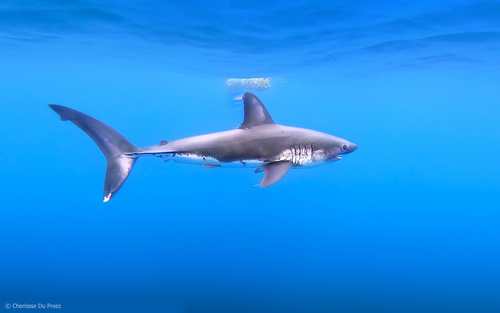
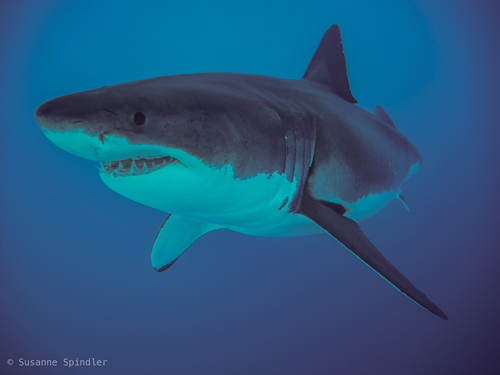
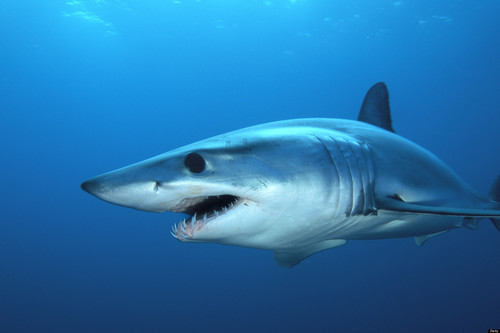
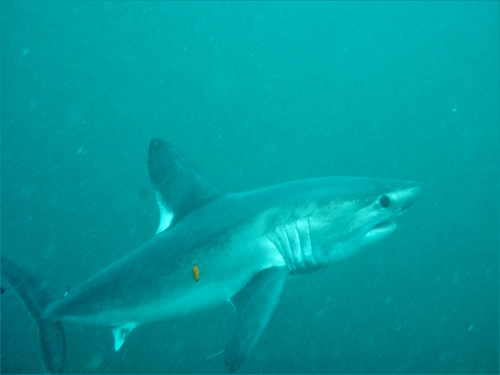
This species is Lamna nasus, the porbeagle, a stout-bodied shark with a fusiform (spindle-like) shape. It has a long, conical snout that tapers to a sharp point, supported by enlarged, highly calcified rostral cartilages. Its eyes are large and black, and lack nictitating membranes (protective third eyelids). Small, S-shaped nostrils sit in front of and below the level of the eyes. The mouth is large and strongly curved, with moderately protrusible jaws. North Atlantic porbeagles have 28–29 upper tooth rows and 26–27 lower tooth rows, while Southern Hemisphere individuals have 30–31 upper tooth rows and 27–29 lower tooth rows. Each tooth has a strongly arched base and a nearly straight, awl-like central cusp. All but the smallest individuals have a pair of smaller cusplets flanking this central cusp. Five pairs of long gill slits are located before the bases of the pectoral fins. The pectoral fins themselves are long and narrow. The first dorsal fin is large and high with a rounded apex, and originates just behind the pectoral fin bases. Pelvic fins are much smaller than the first dorsal fin. The second dorsal and anal fins are smaller still, positioned approximately even with each other on narrow bases that allow side-to-side pivoting. The sides of the caudal peduncle are expanded into prominent lateral keels, with a second shorter pair of keels located below the main keels. The caudal fin is large and crescent-shaped, with the lower lobe almost as long as the upper lobe. Both dorsal and ventral precaudal pits (depressions) sit at the base of the caudal fin, and a deep ventral notch is located near the tip of the upper caudal fin lobe. The porbeagle's skin is soft, covered in tiny, flattened dermal denticles (scales) that give it a velvety texture. Each denticle has three horizontal ridges that lead to small teeth on its posterior margin. Dorsal coloration ranges from medium to dark gray or slate, extending to the bases of the pectoral fins. The underside is white; adult Southern Hemisphere porbeagles often have dark coloring under the head and dusky blotches scattered across the belly. A unique identifying feature of this species is that the free rear tip of the first dorsal fin is abruptly light gray or white. The porbeagle may reach a length of 3.7 m (12 ft), though this measurement is uncertain and may have come from confusion with other mackerel shark species. A more typical adult length is 2.5 m (8.2 ft). In the North Atlantic, females grow larger than males: the maximum confirmed fork length (measured from snout tip to the caudal fin fork) is 2.5 m (8.2 ft) for males and 3.0 m (9.8 ft) for females. Southern Hemisphere porbeagles are smaller, with the two sexes having similar sizes: males reach a fork length of 2.0 m (6.6 ft) and females 2.1 m (6.9 ft). Most porbeagles weigh no more than 135 kg (298 lb); the record weight is 230 kg (510 lb) for an individual caught off Caithness, Scotland, in 1993. The porbeagle has an almost global amphitemperate distribution, meaning it is absent from the tropics; in the North Pacific, its ecological niche is filled by the salmon shark. It is found mostly between 30–70°N and 30–50°S latitudes. In the North Atlantic, its northern range limit extends from the Newfoundland Grand Banks off Canada, through southern Greenland, to Scandinavia and Russia; its southern range limit extends from New Jersey and Bermuda, through the Azores and Madeira, to Morocco. It occurs in the Mediterranean Sea, but not the Black Sea. Normally, North Atlantic porbeagles only stray as far south as South Carolina and the Gulf of Guinea, but pregnant females from the western North Atlantic population are known to enter the Sargasso Sea, reaching almost as far as Hispaniola, to give birth. In the Southern Hemisphere, the porbeagle apparently occupies a continuous band bounded to the south by the Antarctic Convergence, and extending as far north as Chile and Brazil, South Africa's Western Cape province, Australia (to southern Western Australia and southern Queensland), and New Zealand. In New Zealand, it is most common south of the Cook Strait. It is thought that the porbeagle colonized the Southern Hemisphere during the Quaternary glaciation (starting around 2.6 million years ago), when the tropical climate zone was much narrower than it is today. The porbeagle favors offshore fishing banks as habitat, though it can be found across the entire water column, from depths of 1,360 m (4,460 ft) in oceanic basins to littoral (nearshore) waters less than 1 m (3.3 ft) deep. There is a single anomalous record of a juvenile porbeagle in brackish water in Mar Chiquita, Argentina. A tracking study off the British Isles found substantial variation in the short-term movements of this species, both between and within individuals. Vertical movement tended to increase with water depth and corresponding temperature stratification. In shallow, unstratified waters, porbeagles either showed no pattern in depth changes or made reverse diel movements, staying in shallow water during the day and descending at night. In deeper, stratified waters, porbeagles performed a regular diel migration, staying below the thermocline during the day and rising toward the surface at night. The porbeagle has been recorded in water temperatures from 1 to 23 °C (34 to 73 °F), with most records falling between 8 and 20 °C (46 to 68 °F). In one study of 420 porbeagles caught in the northwest Atlantic off Canada, all were found in water below 13 °C (55 °F), and the majority were found between 5 and 10 °C (41 and 50 °F). Northern and Southern Hemisphere porbeagle populations appear to be completely separate. There are two stocks in the North Atlantic (eastern and western) that seldom mix; only one individual is known to have crossed the Atlantic, traveling 4,260 km (2,650 mi) from Ireland to Canada. Several separate stocks are also likely present in the Southern Hemisphere. This species segregates by size and sex in the North Atlantic, and at least by size in the South Pacific. For example, males outnumber females 2:1 off Spain, females are 30% more numerous than males off Scotland, and immature males are predominant in the Bristol Channel. Older, larger porbeagles often frequent higher latitudes than younger individuals. Seasonal migrations have been observed in porbeagles from both hemispheres. In the western North Atlantic, much of the population spends spring in the deep waters of the Nova Scotia continental shelf, then migrates 500–1,000 km (310–620 mi) north to spend late summer and fall in the shallow waters of the Newfoundland Grand Banks and the Gulf of St. Lawrence. In December, large mature females migrate over 2,000 km (1,200 mi) south into the Sargasso Sea to pup, staying deeper than 600 m (2,000 ft) during the day and 200 m (660 ft) at night to remain in the cooler waters beneath the Gulf Stream. In the eastern North Atlantic, porbeagles are believed to spend spring and summer in shallow continental shelf waters, and disperse northwards to overwinter in deeper offshore waters. Migrating porbeagles may travel up to 2,300 km (1,400 mi), though once they reach their destination they tend to stay within a relatively localized area. In the South Pacific, the porbeagle population shifts north past 30°S latitude into subtropical waters in winter and spring, and retreats south past 35°S latitude in summer, when sharks are frequently sighted off subantarctic islands. Fast and energetic, the porbeagle can be found alone or in groups. Its fusiform body, narrow caudal peduncle with lateral keels, and crescent-shaped tail are adaptations for efficiently sustaining speed; these traits have also evolved independently in tunas, billfishes, and several other groups of active fishes. Along with the salmon shark, it is the thickest-bodied member of its family, with a length-depth ratio approaching 4.5, and consequently has the stiffest swimming style. Porbeagles oscillate their tails while holding their bodies mostly rigid, which provides propulsive power with high energy efficiency, but reduces maneuverability. The porbeagle's large gill surface area delivers more oxygen to its tissues. It also has a short band of aerobic "red muscle" along each side, which can contract independently of regular "white muscle" at a lower energy cost, improving the shark's stamina. Porbeagles are among the few fish that show apparent play behavior. Reports, mainly from off the Cornish coast, describe this species rolling and repeatedly wrapping itself in long kelp fronds near the surface; this activity may have an exploratory or self-stimulatory purpose, though alternatively the sharks may be attempting to feed on small organisms living on the kelp or scrape off parasites. Additionally, porbeagles in groups have been observed chasing each other, and they are reported to "play with anything floating on the water"; individuals have been seen prodding, tossing, or biting natural and artificial objects, including pieces of driftwood and balloon floats used by anglers. Great white sharks (Carcharodon carcharias) and killer whales (Orcinus orca) are plausible, though unconfirmed, predators of the porbeagle. One small porbeagle caught off Argentina carried bite marks from a copper shark (Carcharhinus brachyurus) or a similar species, but it is unclear if the porbeagle was the target of attempted predation or if the encounter was simply interspecific aggression. Known parasites of this species include the tapeworms Dinobothrium septaria and Hepatoxylon trichiuri, and the copepods Dinemoura producta, Laminifera doello-juradoi, and Pandarus floridanus. Natural annual mortality is low; in the western North Atlantic, it is estimated to be 10% for juveniles, 15% for adult males, and 20% for adult females.