About Lamna ditropis Hubbs & Follett, 1947
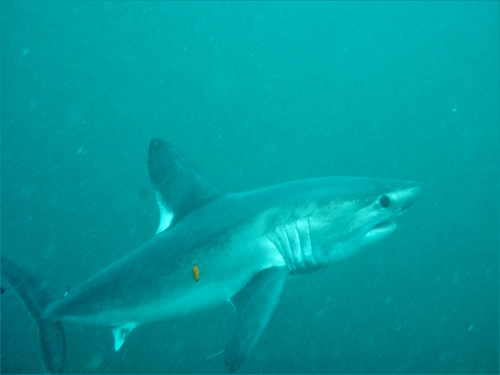
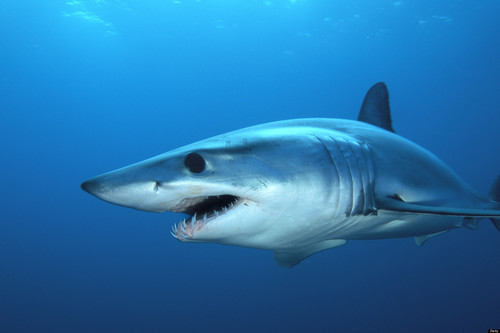
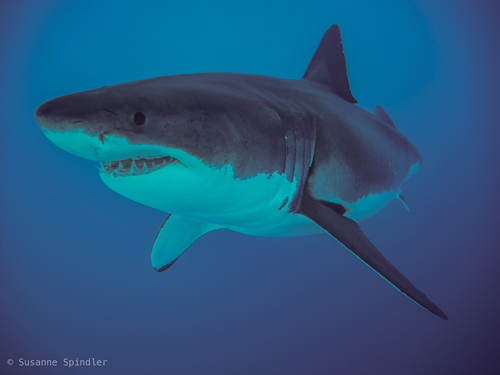
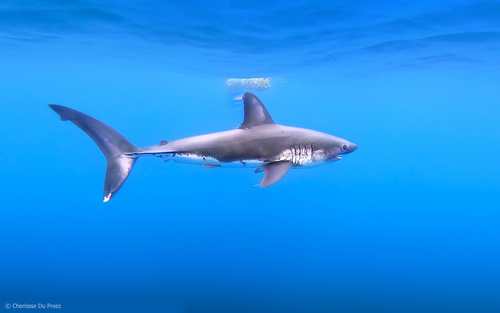
Adult salmon sharks (Lamna ditropis) have most of their body colored medium grey to black, with a white underside marked by darker blotches. Juveniles look similar to adults but typically do not have these blotches. This species has a short, cone-shaped snout, and its overall appearance resembles a small great white shark. Its eyes are positioned well forward, which allows it to use binocular vision to accurately locate prey. Most adult salmon sharks grow to between 200 and 260 cm (6.6–8.6 ft) in length, and can weigh up to 220 kg (485 lb). Males reach a slightly smaller maximum size than females. Unconfirmed reports claim salmon sharks can reach up to 4.3 m (14.2 ft) in total length, but the largest confirmed maximum total length is about 3.0 m (10 ft). Claims that the maximum weight of salmon sharks exceeds 450 kg (992 lb) are unsubstantiated. Salmon sharks have a wide, double keeled tail, meaning they have a second short ridge running along the upper part of the lower lobe of the tail. The only other shark with a double keeled tail is the closely related porbeagle shark. Salmon sharks are voracious hunters that can hunt alone or in groups. Groups of 30 to 40 individuals have been observed hunting salmon in Alaskan waters. They often congregate in large groups in coastal waters to hunt bony fish such as salmon. Prey consumption studies show that salmon sharks have energetic requirements similar to sea lions and other piscivorous marine animals. This species is relatively common north of the equator in continental offshore waters of the northern Pacific Ocean, where it ranges from inshore to just off the coast. Tagging studies show its range extends from sub-Arctic to subtropical waters. It is believed to range as far south as the Sea of Japan and as far north as 65°N in Alaska, and large numbers regularly appear in Prince William Sound during the annual salmon run. Individual salmon sharks have been observed diving as deep as 668 m (2,192 ft), but they are thought to spend most of their time in epipelagic waters. While they primarily travel alone or in small feeding aggregations, they may sometimes be seen in larger schools. A 2008 study found that salmon sharks use area-restricted search behaviors in both northern and southern regions of the Pacific Ocean. Individuals migrating through southern high-productivity regions exhibit this behavior more often than those traveling through low-productivity regions. This species moves quickly during migration; migration studies have recorded an average travel distance of 33 km per individual. Juvenile salmon sharks stay mostly in more coastal regions along the west coast of North America. They prefer water temperatures between 12 and 16°C, and feed on a variety of mesopelagic (intermediate depth) and epipelagic (upper sunlit water column that supports photosynthesis) offshore prey. The salmon shark is ovoviviparous, and gives birth to litters of two to six pups. Like other lamniform shark species, it is oophagous, meaning developing embryos feed on ova produced by the mother. Females reach sexual maturity between eight and ten years of age, while males generally reach sexual maturity by age five. Reproductive timing for the species is not well understood, but it is thought to follow a two-year reproductive cycle, with mating taking place in late summer to early autumn. Gestation lasts approximately nine months. Some reports suggest the sex ratio at birth may be 2.2 males to 1 female, but it is unknown how widespread this ratio is. Newborn salmon sharks are completely independent, and pups are born off the coast of Baja California.