About Lagria villosa (Fabricius, 1781)
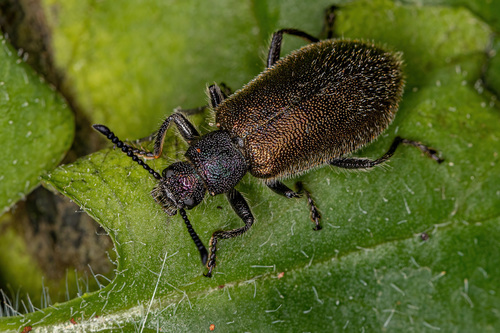
Lagria villosa (Fabricius, 1781) is a member of the Tenebrionidae beetle family, originally native to tropical and subtropical Africa, and it is an invasive species in South America. Both larvae and adult L. villosa feed on a wide range of crops, including sorghum, pineapple, bananas, coffee, potatoes, corn and peach. This beetle also transmits multiple bacterial pathogens belonging to the genera Fusarium and Pseudomonas, and is classified as a significant crop pest. The first recorded occurrences of this species outside Africa were in Brazil in 1976. Currently, the insect is established across large areas of Brazil, Bolivia, Paraguay and northern Argentina. The first recorded specimen of L. villosa found in Europe was collected in Finland in 2020, inside a box of table grapes shipped from Brazil. L. villosa can be easily distinguished from all other European Lagria species by two key characteristics. For L. villosa, the body integuments are dark with purple-green metallic reflections, while other European Lagria species have brown to black integuments. Additionally, the elytra of L. villosa have copper and golden coloring, while the elytra of European Lagria species range from pale yellow to black-brown. These beetles live in symbiosis with a strain of the bacterium Burkholderia gladioli. This symbiotic bacterium produces a polyketide called lagriamide that protects the beetle's eggs from both fungal and bacterial infections. Under controlled laboratory conditions, the symbionts protect the beetle's eggs from fungal infections while they are present on the egg surface during vertical transmission. Lagriamide is structurally similar to bistramides such as bistramide A, which carry out similar defensive functions in marine tunicates.