About Lagonosticta rubricata (Lichtenstein, 1823)
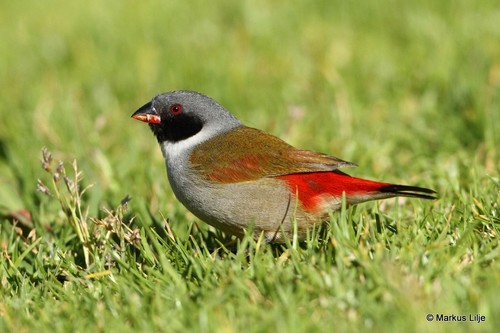
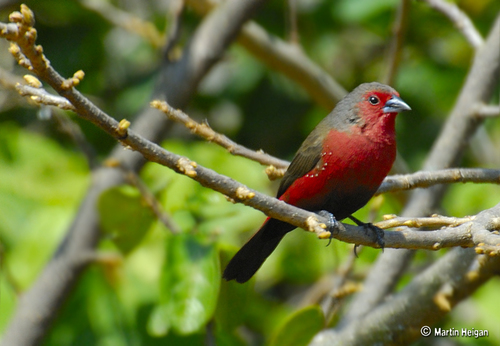
The African firefinch (scientific name Lagonosticta rubricata (Lichtenstein, 1823)) is a small species of estrildid finch. Its overall plumage is red, or a combination of red and brown. Males have a lead grey crown, nape, and neck, which transitions into an olive brown mantle. The scapulars, wing coverts, and tertials are also olive brown, and sometimes carry a faint grey tinge. The rump, uppertail coverts, and outer tail feathers are deep carmine red, while the remainder of the tail is black. The underparts, from the chin down to the belly, are deep scarlet, with small white spots on the upper breast and flanks. The scarlet plumage on the flanks extends to the side of the rump. The center of the belly is greyish, and this colour becomes black on the vent and undertail coverts. The bird's short, pointed bill is blackish-grey, with a pink base to the lower mandible. Females are similar in appearance to males, but their colouration is less intense. Juveniles have no red colouring on their underparts at all. This species measures 10–11 cm (3.9–4.3 in) in total length, and weighs between 8.6–11.7 g (0.30–0.41 oz). The African firefinch is found in disconnected patches across sub-Saharan Africa. Its range extends from Senegal east to Ethiopia, then south to the southern Democratic Republic of the Congo and Tanzania, and continues south through Mozambique to the Eastern Cape province of South Africa. It generally favours humid, thickly vegetated habitats. These include bracken (Pteridium aquilinum) at forest edges, savanna with acacia woodland, rank grass growing within and under scrub or thornbush, and areas along streams and rivers with thick vegetation. It is often found near quiet paths or roads. It can also be seen in and around gardens and rural villages, though it is not as common in these areas as some other firefinch species. The African firefinch feeds mainly on seeds, and supplements its diet with insects. It mostly forages on the ground, searching through soil to find food. It lives in pairs or small family groups, and may mix with other firefinch species. It stays close to cover, and will retreat quickly into cover if it becomes alarmed.