About Lagocephalus sceleratus (Gmelin, 1789)
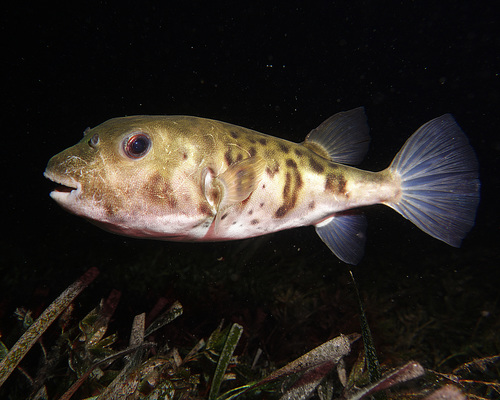
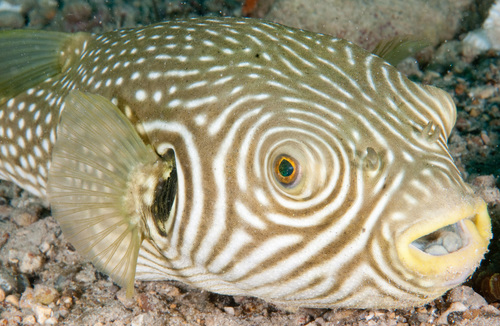
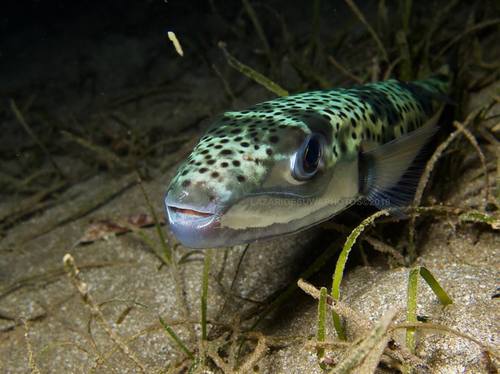
The silver-cheeked toadfish, scientifically named Lagocephalus sceleratus (Gmelin, 1789), is very similar to oceanic pufferfish, but has a more elongated body and a symmetrical caudal (tail) fin. Its back is grey or brown with darker spots, and it has a white belly. A characteristic silver band runs along the sides of the fish. This species can grow up to 40 centimetres (16 inches) long.
The silver-cheeked toadfish is common in the tropical waters of the Indian and Pacific oceans. It is a recent Lessepsian migrant that entered the eastern Mediterranean Sea through the Suez Canal, and is currently spreading toward the western Mediterranean. Individuals have been caught off the coasts of Israel, southern Turkey, Cyprus, the southern coasts of mainland Greece, Crete, and Rhodes. In 2013, the species was reported in waters off Lampedusa Island in the central Mediterranean; in 2015, it was reported off Malta, and also in waters near the town of Bečići, Montenegro, in the southeastern Adriatic Sea. One specimen was caught in Gruissan (Aude, France) in the summer of 2014. Greek authorities issued an alert regarding this fish. A few days before 9 February 2022, a specimen was caught by Croatian fishermen near the island of Pašman in the Adriatic; the Croatian Institute of Oceanography and Fisheries posted a warning to its Facebook page about the dangers of handling and consuming the fish. Currently, the westernmost confirmed record of the species is from the Strait of Gibraltar. In its native Red Sea range, the silver-cheeked toadfish inhabits rocky bottoms, ranging from shallow coastal waters down to a depth of 250 metres (820 feet). In December 2018, A Semana, a newspaper based in the Cape Verde Islands, reported that this fish had been caught in Cape Verde waters off West Africa, which prompted an alert to all fishermen and the general public about the fatal danger of consuming this fish.
For reproduction, the eggs and larvae of the silver-cheeked toadfish are found in the pelagic zone.