About Lagerstroemia speciosa (L.) Pers.
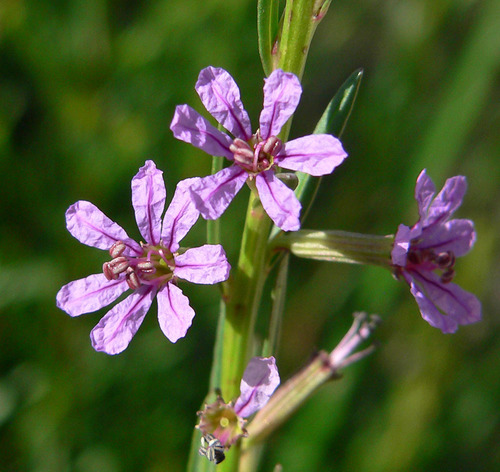
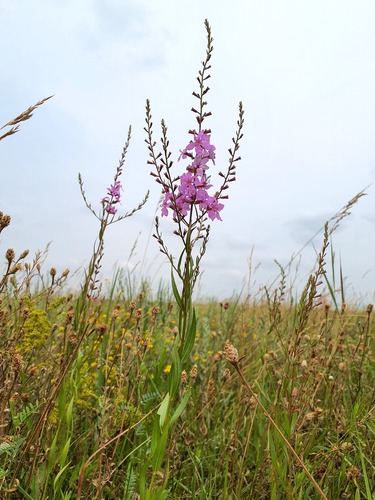
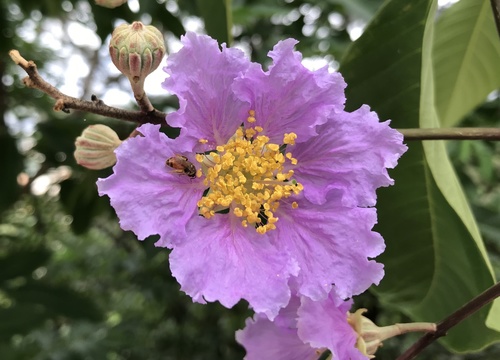
Lagerstroemia speciosa (L.) Pers. is a species of Lagerstroemia that has many common names: giant crepe-myrtle, queen's crepe-myrtle, banabá plant, pride of India, queen's flower, and jarul. This species is a deciduous tree native to tropical South Asia, Southeast Asia, and Melanesia. It produces bright pink to light purple flowers; the flowers can also appear in purple, lilac, or pinkish-violet tones. They grow in large, abundant, attractive blooms that last for many months, and their texture resembles delicate crêpe paper, which gives the plant its common crepe myrtle names. The common name "queen's flower" comes from the former specific epithets 'reginae' or 'flosreginae', which translate to "imperial" or "flower of the queen" respectively. The timber of this tree is second only to teak in strength. The species is native to India, where it grows specifically in the Western Ghats covering Belgaum, north Kanara, south Kanara, Malabar, and Travancore, as well as in Assam and West Bengal. It is cultivated across Southeast Asia, China, India, Bangladesh, the Philippines, and as far as Australia. It is also widely grown as an ornamental plant in tropical and subtropical regions around the world. Various parts of the banabá plant are widely used to make tea in the Philippines, Taiwan, and Japan, and banabá herb is one of the 69 herbal plants promoted by the Philippine Department of Health. In Vietnam, the plant's young leaves are eaten as vegetables, while old leaves and mature fruit are used in traditional medicine to lower blood glucose. The seeds of Lagerstroemia speciosa have narcotic properties. Medicinally, the bark and leaves act as a purgative, the roots are astringent, stimulant, and febrifuge (fever-reducing), and a leaf decoction is used to treat diabetes. In Manipur, the fruit of this tree is applied locally for mouth apathy.