About Lagenorhynchus obscurus (Gray, 1828)
Scientific name: Lagenorhynchus obscurus (Gray, 1828)
Description: The dusky dolphin is a small cetacean. For New Zealand specimens, female lengths range from 167–178 cm (5.48–5.84 ft) and weights from 69–78 kg (152–172 lb); male lengths range from 165–175 cm (5.41–5.74 ft) and weights from 70–85 kg (154–187 lb). Peruvian dusky dolphins may grow larger, though this conclusion is based on small sample sizes: one measured female was 204.5 cm (6.71 ft) long, and one measured male was 206 cm (6.76 ft) long. Off the coast of Peru, newborn dusky dolphins have an average length of 91.2 cm (2.99 ft) and an average weight of 9.6 kg (21 lb).
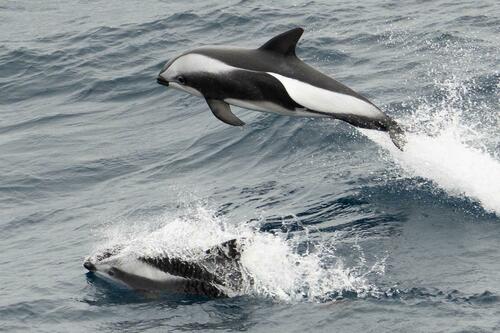
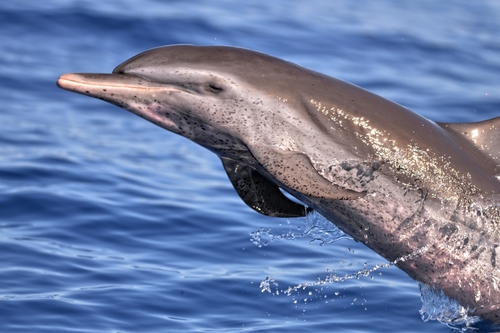
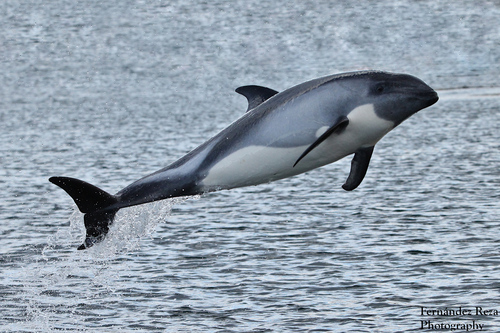
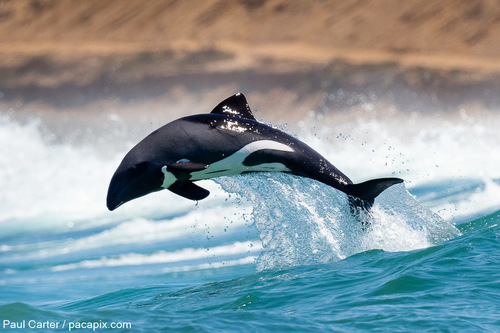
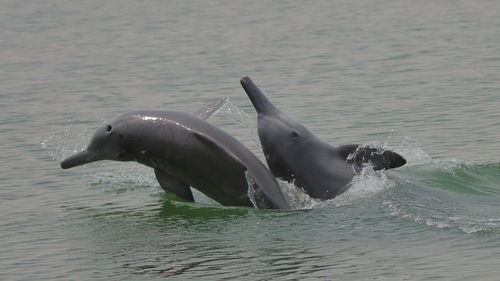
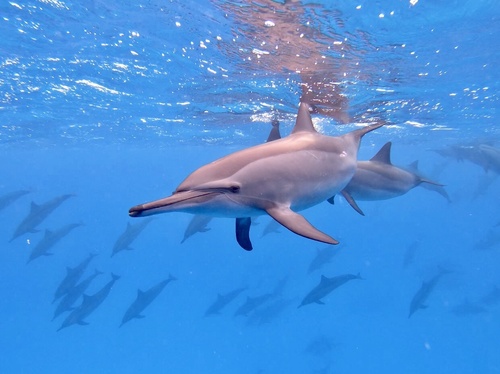
The species has a somewhat stocky build, with a short, pointed beak and curved dorsal fin and flippers. It has between 108 and 144 small, conical teeth. It has a distinctive colouration that resembles the Pacific white-sided dolphin: its upper side, orbital (eye) region, and beak are dark-grey or black; its face, chest area, and flank patch are light-grey; and its underside is white. The flank patch has an extension or blaze that stretches over the back toward the blowhole. The front of the dorsal fin is darker, and it lightens toward the back; the flippers are light-grey with darker edges. The dusky dolphin differs from the Pacific white-sided dolphin by having a more slender skull and a shorter blaze.
Distribution: The dusky dolphin has a discontiguous range in the Southern Hemisphere, including the coasts of western and southeastern South America, southwestern Africa, New Zealand, and some oceanic islands in the south Atlantic and Indian Ocean. It has also been sighted off southern Australia. Dusky dolphins can be found throughout New Zealand waters, and are most common along the eastern coasts, between East Cape on the North Island and Timaru/Oamaru on the South Island. They are sighted year-round in the stable, cold waters off the coast of the northern Canterbury Region.
Off South America, their range extends from southern Peru to Cape Horn in the Pacific, then up to around 36°S in the Atlantic, including the Falkland Islands, where they are thought to be less abundant. Off Africa, the dusky dolphin ranges from Lobito Bay, Angola, in the north to False Bay, South Africa, in the south. Within Australian waters, dusky dolphins have been recorded off Kangaroo Island, eastern Tasmania, and in the Bass Strait, although they are uncommon there and may be transients from New Zealand. Dusky dolphins are also found around the islands of Tristan da Cunha, Prince Edward, Crozet, Île Amsterdam, and Île Saint-Paul.
Ecology and behaviour: Dusky dolphins live mostly in coastal waters within the continental shelf, and prefer cool, upwelling waters as well as cold currents. Dolphins off Argentina and New Zealand move between shore and open water over the course of a day and between seasons. Seasonal migrations have been recorded between Kaikōura and Admiralty Bay, New Zealand. Around Kaikōura, the majority of individuals have only been seen once in the area over a 30-year period, suggesting high levels of immigration and emigration. Dusky dolphins have been recorded swimming up to 10 metres per second (36 km/h; 22 mph) and diving up to 130 m (430 ft).
Most studies of foraging and social behaviour of this species have been conducted at Kaikōura, Admiralty Bay, and San Jorge Gulf, Argentina. Dusky dolphins live in a fission–fusion society, where individuals move in and out of groups depending on social and environmental conditions. At Kaikōura, group sizes can reach 1,000 dolphins, while in Admiralty Bay, group sizes peak at around 50 dolphins. Groups form for different activities, including foraging, resting, travelling, and socialising. At Kaikōura, groups are larger when resting and smaller when foraging, but the reverse is true at San Jorge Gulf. At Admiralty Bay, foraging leads to larger aggregations; resting does not appear to correlate with group size. Most associations between individuals are weak, but long-term bonds do occur.
Dusky dolphins can be found in mixed groups with other cetacean species, including common dolphins, southern right whales, Risso's dolphins, southern right whale dolphins, and pilot whales. Off Argentina, they have been found around bottlenose dolphins, but they appear to ignore bottlenose dolphins. Dusky dolphins also feed alongside non-cetacean species: off Argentina these include South American sea lions, kelp gulls, cormorants, terns, shearwaters, petrels, albatrosses, and Magellanic penguins, while off New Zealand these include Australasian gannets, shearwaters, terns, gulls, spotted shags, New Zealand fur seals, spiny dogfish, and common threshers.
Reproduction and parenting: Dusky dolphins reach sexual maturity between four and eight years of age, differing by region. They have a polygynandrous mating system in which both males and females mate with multiple partners. As a result, males have large testes for sperm competition. Mating groups typically consist of multiple males and one female; at Kaikōura, groups usually have a total of five members, but can range from two to fifteen. Mating groups can be found in both shallow and deep water, but more often congregate near shore. Within a mating group, males pursue a female in a high-speed chase. Females appear to prefer males with great speed and agility over size, strength, or aggression, and try to evade males that are less energetic and lack social skills. Males also form alliances to capture females.
Off Kaikōura, dusky dolphins have been found to have scars and notches on their dorsal fins, which are thought to be caused by aggression between males and toward females during mating. A study in the same area did not observe aggression in mating groups; males did not fight among themselves or control who could be part of the group, but they did interfere with copulations. During mating, female dusky dolphins usually take the top position. Dusky dolphins also engage in non-reproductive sexual behaviour, including homosexual behaviour, which may serve for greeting, communication, or strengthening social bonds; this behaviour does not involve high-speed chasing. Female dusky dolphins off the coast of Peru were found to have gestation periods of over 12 months.
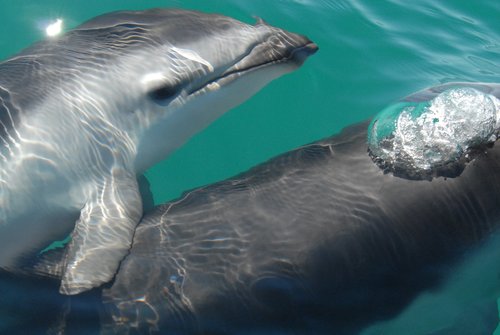
Calves are born during the spring (August to October) off Peru, and in summer (November to February) off Argentina, South Africa, and New Zealand. Females with calves tend to gather in nursery groups, which may provide mothers more time to rest and facilitate socialisation among the young. Calves learn to hunt from their mothers, and nursery groups typically forage in shallow water because deeper water is too dangerous for young, particularly due to predators. Nursery groups stay away from mating groups, as adult males will aggressively chase mothers and leave calves dazed and vulnerable. In contrast, females with calves will associate with non-breeding adults in large groups. Near Peru, calves may be weaned around 12 months, and females can breed again less than four months after weaning.