About Lagenorhynchus cruciger (Quoy & Gaimard, 1824)
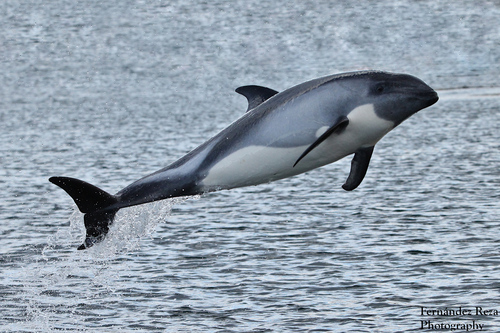
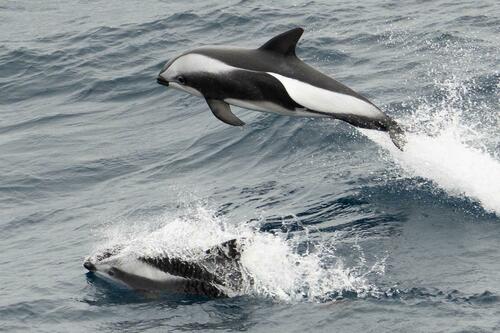
The hourglass dolphin (scientific name Lagenorhynchus cruciger) is black on its upper side and white on its belly, with white patches on its sides; some individuals also show dark grey variations. Because of this distinctive patterning, whalers historically called it the colloquial names "sea cow" (though it is not part of the taxonomic order Sirenia) or "sea skunk".
On each flank, there is one white patch at the front, located above the beak, eye, and flipper, and a second white patch at the rear. A thin white strip connects these two patches, creating a loose hourglass shape, which gives the species its common name. Individual markings can vary between different dolphins. The species epithet cruciger means "cross-carrier", and refers to the black dorsal area, which vaguely resembles a Maltese cross or cross pattée when viewed from above. Within its usual range, the hourglass dolphin is easy to identify. The only cetacean with a similar size, similar coloration, overlapping distribution, and range this far south is the southern right whale dolphin. Southern right whale dolphins have no dorsal fin, while hourglass dolphins typically have a tall, curved dorsal fin, so confusing the two species is very unlikely. The shape of the hourglass dolphin's dorsal fin varies between individuals, and curvature tends to be more pronounced in older animals. Hourglass dolphins have disk-shaped vertebrae and other inclined processes that give them higher physical stability.
Adult males are roughly 1.8 meters (5.9 feet) long and weigh over 90 kilograms (about 200 lbs). Juvenile females range from 1.6 to 1.8 meters (5.2 to 5.9 ft) in length and weigh between 70 and 90 kg (150 to 200 lb). Although the hourglass dolphin is a small dolphin species, it is extremely fast and agile. Researchers suspect males are slightly smaller and lighter than females, but very few specimens have been studied so no firm conclusion can be drawn. Female gestation is estimated to last 12.9 months, and females generally give birth between mid-July and October. Hourglass dolphins have between 26 and 34 teeth in their upper jaw, and between 27 and 35 teeth in their lower jaw. Like all dolphin species, they use echolocation to locate food. There have been no verified sightings of hourglass dolphin calves, so the coloration, size, and diet of calves remain unknown.
The hourglass dolphin has a circumpolar range, extending from near the Antarctic pack ice north to approximately 45°S. The northernmost confirmed sightings are at 36°S in the South Atlantic Ocean and 33°S near Valparaíso, Chile in the Pacific Ocean. Most of the species' circumpolar distribution falls between 45°S and 67°S. Very few sightings have occurred near islands, and the majority of sightings are in the Southern Ocean. The most common sites of sightings are south of New Zealand, around the South Shetland Islands, and off Tierra del Fuego, Argentina.
The hourglass dolphin is a fully Antarctic species. It prefers colder water, so it spends most of its time close to the surface where water temperatures range from -0.3°C to 7°C. The warmest water hourglass dolphins have been reported in is 14°C. Hourglass dolphins are migratory: they move farther south during the austral summer, and farther north during the austral winter.