About Lagenorhynchus australis (Peale, 1848)
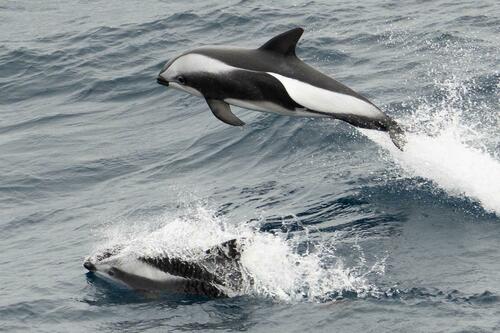
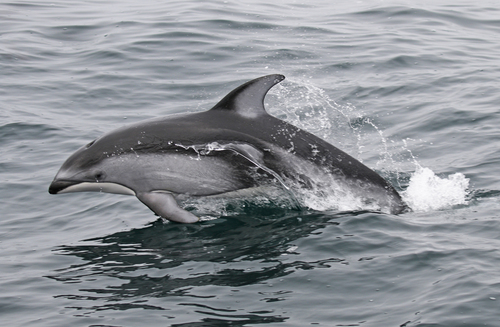
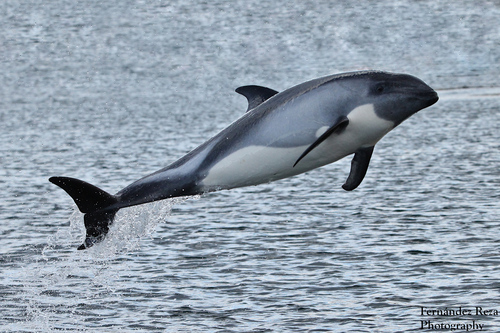
Peale's dolphin, with the scientific name Lagenorhynchus australis (Peale, 1848), has a body size typical for its family. Newborn individuals measure around 1 m (3 ft 3 in) in length, while fully mature adults reach 2.1 m (6 ft 11 in) and weigh approximately 115 kg (254 lb). This species has a dark grey face and chin, and a mostly black back. A single off-white stripe runs along each side of the back, curving and thickening as it extends toward the tail. Its belly is white, and a prominent white patch known as an "armpit" sits just behind each flipper. The flanks also have a large white-grey patch located above the flipper. The dorsal fin is large relative to the dolphin's size, with a distinctively falcate shape. The flippers themselves are small and pointed, and the tail fin has pointed tips with a central notch. At a distance, Peale's dolphin closely resembles the dusky dolphin, and the two are easily confused. Peale's dolphin is endemic to the coastal waters surrounding southern South America. On the Pacific side of the continent, individuals have been sighted as far north as Valdivia, Chile, at 38°S. On the Atlantic side, sightings become uncommon at approximately 44°S, near Golfo San Jorge, Argentina. To the south, the species has been recorded at almost 60°S, extending well into the Drake Passage. It is commonly found in areas with fast-moving water, including channel entrances and narrows, as well as close to shore in sheltered areas like bays. The total global population of Peale's dolphin is unknown, but recent research estimates there are roughly 21,800 individuals in the South Atlantic portion of the species' range. In the southwestern South Atlantic, Peale's dolphin forages within coastal ecosystems. It feeds mainly on demersal and bottom-dwelling fish such as southern cod and Patagonian grenadier. Octopus, squid, and shrimp have also been found in the stomachs of examined individuals. Peale's dolphins feed in or near kelp beds and in open waters, and they hunt cooperatively. Cooperative feeding strategies include forming straight lines, large circles, or star-burst formations where large groups encircle their prey.