About Lagenaria siceraria (Molina) Standl.
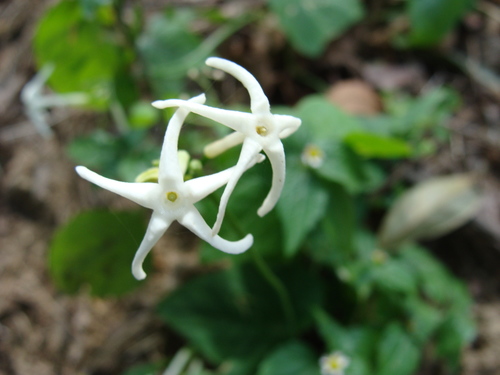
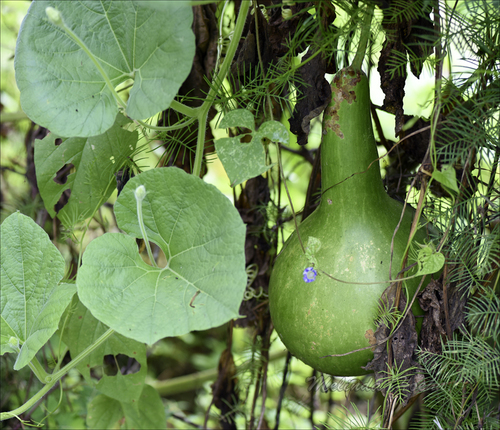
Lagenaria siceraria, commonly called calabash, bottle gourd, white-flowered gourd, long melon, birdhouse gourd, New Guinea bean, New Guinea butter bean, Tasmania bean, zucca melon, and opo squash, is a fruiting vine in the Cucurbitaceae family. It is native to tropical Africa and cultivated throughout the tropics. Its fruit can be harvested young to eat as a vegetable, or harvested mature, dried, and used as kitchen utensils (most often ladles or bowls), beverage containers, or musical instruments. Fresh fruit has light green, smooth skin and white flesh. Calabash fruits come in a wide range of shapes: they may be large and rounded, small and bottle-shaped, or slim and serpentine, and can grow to over a metre long. Rounded varieties are typically classified as L. s. var. depressa, the common calabash gourd, and can grow to very large sizes. A calabash grown in Taylorsville, Kentucky in 2001 weighed 111.5 kg, or 246 lb. This gourd was one of the first plants in the world cultivated primarily not for food, but for use as containers. The bottle gourd may have spread from Asia to Africa, Europe, and the Americas either through human migration, or via seeds that floated across oceans inside the fruit. Evidence confirms it was domesticated globally and already present in the New World during the Pre-Columbian era. Discussion of the term "calabash" often causes confusion, because the same name is used for the unrelated calabash tree, Crescentia cujete, whose hard, hollow fruits are also used to make utensils, containers, and musical instruments. Like other members of the Cucurbitaceae family, bottle gourds contain cucurbitacins, compounds that are cytotoxic at high concentrations. These tetracyclic triterpenoids, found in cucurbit family fruits and vegetables, create the characteristic bitter taste of toxic gourds and can cause stomach ulcers. In extreme cases, people have died after drinking bitter bottle gourd juice. Most reported toxic cases involve gourds used to make juice that drinkers noted tasted unusually bitter. Three of the recorded lethal cases involved diabetics in their 50s and 60s. In 2018, a healthy woman in her 40s was hospitalized after consuming bottle gourd juice, and died three days later from complications. The plant is not normally toxic when eaten. Excessively bitter, toxic gourds develop from improper storage (including temperature swings or high storage temperatures) and over-ripening. Bottle gourds are cultivated by either direct sowing of seeds, or transplanting 15- to 20-day-old seedlings. The plant prefers well-drained, moist soil rich in organic matter. It needs plenty of moisture during the growing season, and a warm, sunny location sheltered from wind. It can be grown in small spaces such as pots, with vines allowed to spread over a trellis or roof. In rural areas, many thatched-roof houses are fully covered with growing bottle gourd vines. Bottle gourds grow very rapidly; their stems can reach 9 m in length during the summer, so they need solid support along the stem to climb a pole or trellis. If planted under a tall tree, the vine may grow all the way to the tree's top. To encourage higher fruit yields, farmers sometimes cut off the tip of the vine once it reaches 2 m in length. This forces the plant to grow side branches that produce flowers and bear more fruit. The plant produces night-blooming white flowers. Male flowers have long peduncles, while female flowers have short peduncles and an ovary shaped like the eventual fruit. Female flowers sometimes drop off without forming fruit if pollination fails, which usually happens when no night pollinator (likely a species of moth) is present in the garden. Hand pollination can resolve this issue. The plant's pollen grains are around 60 microns in length. The first crop is ready for harvest within two months, and the first flowers open roughly 45 days after sowing. Each plant can produce one fruit per day for the following 45 days when adequate nutrients are available. Yields range from 35 to 40 tons per hectare over a 3-month growing season cycle.