About Lagarostrobos franklinii (Hook.f.) Quinn
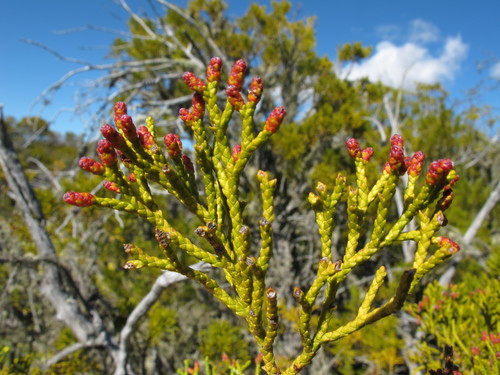
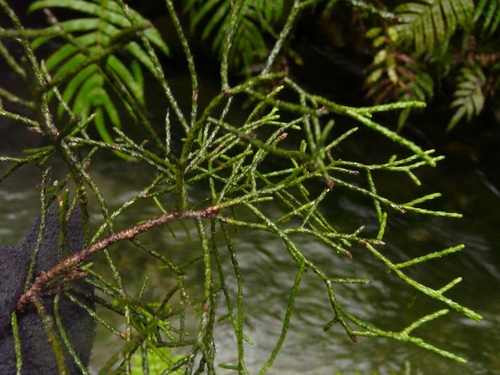
Huon pine, scientifically Lagarostrobos franklinii, is a slow-growing and exceptionally long-lived tree. Some living specimens are over 2,000 years old. It typically grows 10 to 20 metres (33 to 66 feet) tall, and may exceptionally reach 30 metres (98 feet). It has arching branches and pendulous branchlets. Its leaves are spirally arranged, very small and scale-like, 1 to 3 mm (0.039 to 0.118 inches) long, and completely cover the tree’s shoots. This species is dioecious, meaning male pollen cones and female seed cones grow on separate individual plants. Male cones are yellow, 5 to 8 mm (0.20 to 0.31 inches) long and 1 to 2 mm (0.039 to 0.079 inches) broad. Mature seed cones are highly modified and berry-like, with 5 to 10 lax, open scales. These cones take six to eight months to mature, and each scale holds one seed that is 2 to 2.5 mm (0.079 to 0.098 inches) long. Unlike the closely related New Zealand genus Manoao, Huon pine cone scales do not become fleshy. Seeds are water-dispersed, rather than bird-dispersed as seen in Manoao. Estimates from herbarium specimens put the species’ extent of occurrence at approximately 13,363 square kilometres (5,159 square miles), with an estimated area of occupancy also equal to 13,363 square kilometres (5,159 square miles). Estimates of the actual area of occupancy range from 2,500 hectares (6,200 acres), reported by Gibson in 1991, to as much as 10,500 hectares (26,000 acres), published by the Parks and Wildlife Service Tasmania in 2006.