About Lafresnaya lafresnayi (Boissonneau, 1840)
Scientific name: Lafresnaya lafresnayi (Boissonneau, 1840), commonly called the mountain velvetbreast.
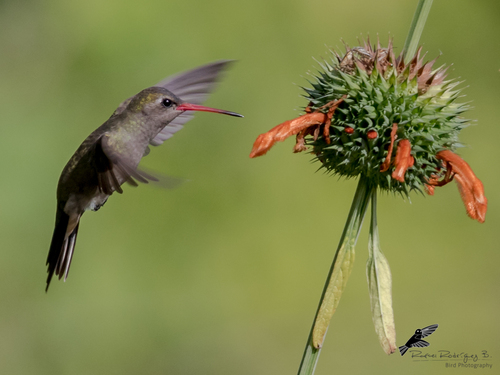
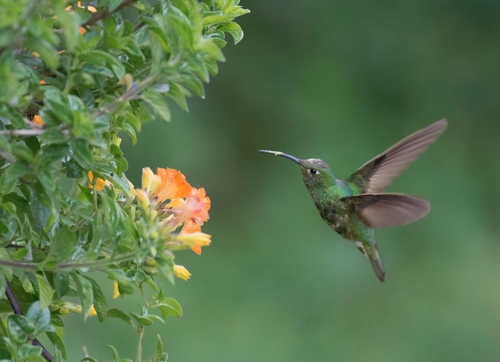
Description: The mountain velvetbreast measures 11.5 to 12 cm (4.5 to 4.7 in) in total length, including its 2.7 to 3.2 cm (1.1 to 1.3 in) bill. It weighs between 4.5 and 6.3 g (0.16 to 0.22 oz). Males have a thin decurved black bill, and the length and curvature of the bill vary between subspecies. Females have a less curved bill than males, and bill features also vary geographically. All subspecies have a white spot behind the eye.
For the nominate subspecies L. l. lafresnayi: Adult males have grass green upperparts. Their throat and breast are iridescent emerald green, and their belly is velvet black. Central tail feathers are bronzy green, and the rest of the tail feathers are buff with black tips. Adult females also have grass green upperparts, and their underparts are buff with iridescent green spots. Juveniles look similar to females, but juvenile males already start developing the black belly.
Other subspecies have the following differences from the nominate: For males of other subspecies, outer tail feathers are whitish instead of buff; for females of other subspecies, underparts are white instead of the nominate's buff. Most subspecies have only minor differences in bill length and curvature compared to the nominate, except: the bill of subspecies L. l. saul is more decurved, and the bill of L. l. orestes is even more decurved. The most recently described subspecies, L. l. longirostris, has the longest bill among all subspecies, though its curvature is only slightly greater than that of the nominate. Subspecies also have some plumage differences: L. l. liriope has coppery green central tail feathers. L. l. greenewalti is similar to the nominate but is paler and more yellowish green. L. l. longirostris has less coppery inner tail feathers than liriope, and is unique among subspecies for having horn- to buff-colored outer tail feathers. L. l. saul has white outer tail feathers with greenish bronze tips. L. l. orestes only differs from the nominate in its much more decurved bill and white outer tail feathers. L. l. rectirostris has a wide black band at the end of its tail feathers.
Distribution and habitat: Each subspecies of mountain velvetbreast has a distinct distribution: L. l. liriope is found in the isolated Sierra Nevada de Santa Marta in northern Colombia. L. l. longirostris is found in the northern part of Colombia's Central Andes. L. l. greenewalti is found in the western Venezuelan states of Trujillo, Mérida, and Táchira. L. l. lafresnayi is found in the extreme southwestern Andes of Venezuela and Colombia's Eastern Andes. L. l. saul is distributed from the Andes of southwestern Colombia, south through Ecuador, to extreme northern Peru. L. l. orestes is found on the east slope of the northern Peruvian Andes south of the Marañón River. L. l. rectirostris is found in the Andes of northern and central Peru.
The mountain velvetbreast primarily inhabits edges of humid montane forest and shrubby slopes, and uncommonly occurs inside forests. In terms of elevation, it generally ranges from 1,800 to 3,400 m (5,900 to 11,200 ft), and is most numerous between 2,000 to 2,800 m (6,600 to 9,200 ft). In Ecuador, it is regularly found up to 3,500 m (11,500 ft), and can be found locally as high as 3,700 m (12,100 ft).