About Laevistrombus canarium (Linnaeus, 1758)
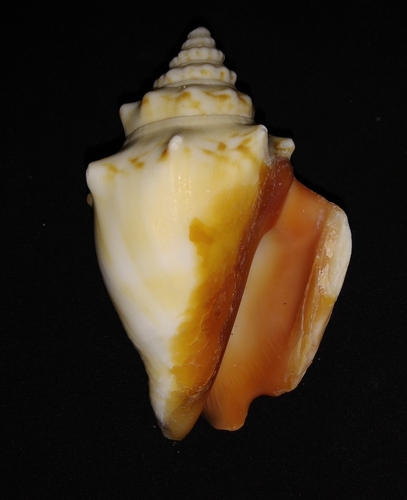
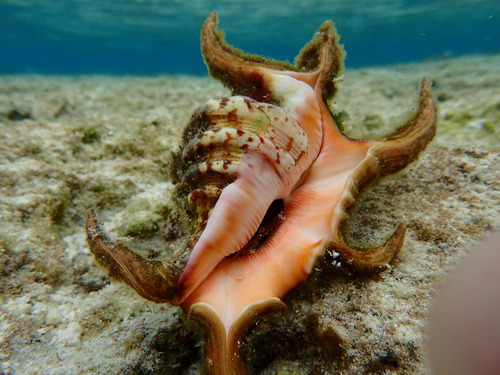
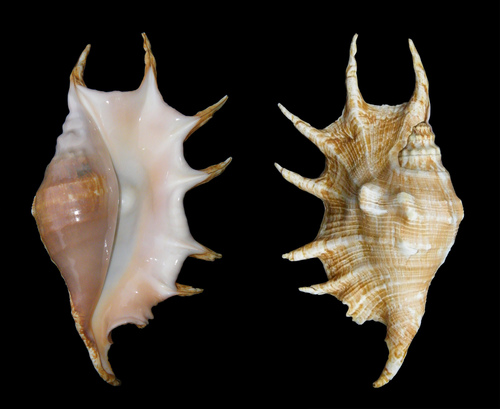
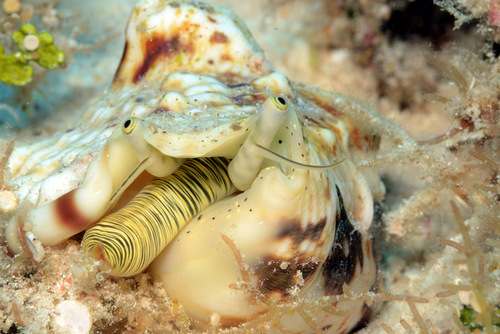
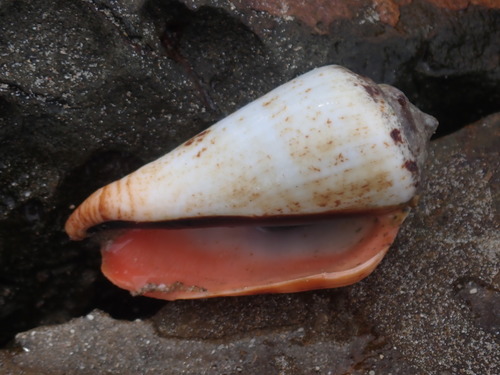
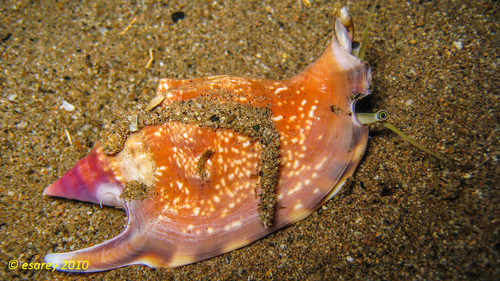
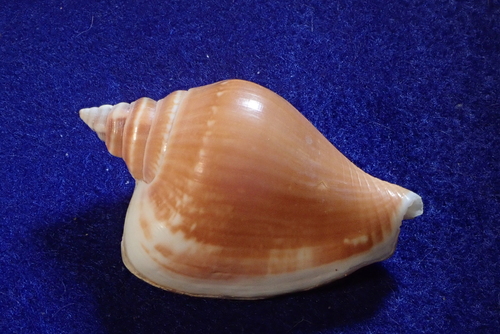
Laevistrombus canarium (Linnaeus, 1758), commonly called the dog conch, has a heavy, rounded-outline shell. Adult shells measure between 29 mm (1.1 in) and 71 mm (2.8 in) in length. The outer shell surface is almost entirely smooth, with only barely visible spiral lines and occasional varices on the spire. Unlike species in the genus Strombus, the stromboid notch on the outer lip is not prominent. When a typical adult dextral (right-handed) shell is viewed ventrally, with the anterior end pointing downward, the stromboid notch appears as a shallow, secondary anterior indentation in the lip to the right of the siphonal canal. The siphonal canal itself is straight, short, and wide; the columella is smooth and lacks any folds. Adult shells have a moderately flared outer lip that protrudes posteriorly, is noticeably thickened, and has no marginal spikes or plicae at all. The body whorl is roundly swollen at the shoulder, with a small number of anterior spiral grooves. The spire is medium-to-high in height, cone-shaped, and includes at least five delicately furrowed whorls. Shell color varies, ranging from golden yellow to light yellowish-brown to grey. The underside of the shell is rarely dark; it is most often paler than the upper surface, or completely white. The shell aperture is always white. Mature specimens sometimes have a metallic-grey or golden-brown gloss on the outer lip margin and the callus. A darker zigzag network of lines sometimes appears on the outer shell surface. The periostracum, the outermost protein (conchiolin) layer of the shell surface, is yellowish-brown. It is typically thick, net-like (reticulated), and fringed (fimbriated) over the suture. The corneous operculum is dark brown, with a shape fairly typical for the family Strombidae: a slightly curved sickle, with seven or eight weak lateral serrations. Laevistrombus canarium is native to the coastal waters of the Indo-Pacific region. Its westernmost recorded distribution is India, including Andhra Pradesh, Tamil Nadu (Gulf of Mannar, Tuticorin, Rameswaram), and the Andaman Islands. It is also found in Sri Lanka (Eastern province, Trincomalee), Thailand, Borneo (Brunei, Sabah), Indonesia (Moluccas, Saparua, Tanjungpinang, Batam, Bintan, Riau Islands) and the Philippines (Cebu Island, Polillo Islands, Palawan). Further east, it occurs in Melanesia, including Yos Sudarso Bay in New Guinea, Papua New Guinea, Malaita and Guadalcanal in the Solomon Islands, New Caledonia, Kioa Island in Fiji, and New Hebrides. The species is also found in Queensland, Australia, and ranges north to Vietnam, Taiwan, and southern Japan. Detailed distribution records exist for the Straits of Johor area and other parts of Malaysia, where it has been reported from Tanjung Adang Shoal, Merambong Shoal, Tanjung Bin, Tanjung Surat and Pasir Gogok in the Johor Straits; Pulau Tinggi, Pulau Besar and Pulau Sibu, Port Dickson and Teluk Kemang in eastern Johor, and Negeri Sembilan; and Pulau Pangkor, Pulau Langkawi, Cape Rachado, and Kilat in the western Johor Straits. The dog conch lives on muddy sand bottoms among algae and seagrass beds on insular and continental shores. It usually prefers major islands and continental coasts over small island shores, though this is not an absolute rule. L. canarium prefers areas of mixed seagrasses dominated by Halophila, and also favors sediment with high organic matter content. This conch avoids environments with a high density of Enhalus acoroides, a large seagrass native to Indo-Pacific coastal waters. The dog conch occurs in the littoral and sublittoral zones, from shallow water down to a depth of 55 m (180 ft). It normally forms large colonies and is usually abundant in areas where it occurs. During the 19th century, strombid gastropods were incorrectly thought to be carnivores. This mistake came from the writings of French naturalist Jean Baptiste Lamarck, whose classification scheme grouped strombids with carnivorous sea snails. Later studies have disproven this idea, confirming that strombid gastropods are herbivorous. Like other members of Strombidae, Laevistrombus canarium is a herbivore that feeds on algae and occasionally detritus. Predators of L. canarium include carnivorous marine gastropods such as the cone snail Conus textile. The dog conch is also preyed on by vertebrates, including the crab-eating macaque Macaca fascicularis, an opportunistic predator that forages in intertidal environments. Humans are one of the main predators of the dog conch, and the species is subject to intensive fishing and exploitation. Empty L. canarium shells are often used by the land hermit crab Coenobita violascens. L. canarium is often parasitized by protists in the phylum Apicomplexa, common mollusk parasites. The coccidian parasites that infect L. canarium belong to the genus Pseudoklossia. These spore-forming, single-celled microorganisms invade the host's kidney cells, and the digestive ducts and tubules of its digestive gland. L. canarium is gonochoristic, meaning each individual is distinctly male or female. The breeding season runs from May through September. After internal fertilization, the female produces and spawns a long, gelatinous tubular structure that holds multiple eggs. This structure coils and compacts to form a creamy-white egg mass. Each egg mass may contain between 50,000 and 70,000 eggs. Over approximately 110 to 130 hours, the L. canarium embryo develops from a single cell into a veliger, the larval form common to marine and freshwater gastropod and bivalve mollusks, and then hatches. The hatching process takes 12 to 15 hours. After hatching, larvae go through four distinct developmental stages during their short planktonic life, grouped by morphological features and other characteristics. Typically, larvae up to 3 days old are stage I veligers; 4- to 8-day-old larvae are stage II; 9- to 16-day-old larvae are stage III; and larvae from 17 days old until metamorphosis are stage IV. L. canarium larvae develop faster than other species in the same family, including the West Indian fighting conch (Strombus pugilis) and the milk conch (Lobatus costatus). Larval development can be strongly affected by environmental conditions such as temperature, and the quality and availability of food. Metamorphosis in L. canarium can be identified by the loss of larval velar lobes and the development of the characteristic leaping motion of juvenile true conches. The flesh of Laevistrombus canarium is edible and widely consumed. This species has significant economic importance and is considered one of the most valuable fishery resources in many coastal regions of Southeast Asia. It is a staple food for local people living along the coast, and is fished in many Southeast Asian countries. In addition to their ornamental value, L. canarium shells are traditionally used by local fishermen as sinkers for fishing nets. Studies conducted from 2008 to 2009 show that L. canarium has been overexploited and overfished in many areas; malacologists and ecologists have recommended reducing harvest rates to maintain the species as a natural resource. Finding large dog conch individuals has become increasingly difficult in several regions where the species lives. Initiatives in Phuket, a southern province of Thailand, aim to rebuild depleted natural L. canarium stocks by reintroducing cultured individuals into local seagrass beds. Fishermen are encouraged not to collect younger, smaller individuals that have not yet reproduced. More recently, researchers in Taiwan have developed aquaculture methods for mass production of L. canarium for human consumption, to reduce pressure on wild populations. Imposex, the development of male sex organs in female animals exposed to human-made organic tin compounds such as tributyltin (TBT), has been detected in L. canarium. Imposex causes negative impacts on many sea snail species, ranging from individual sterility to extinction of entire populations. Tin compounds are biocidal antifouling agents added to paints to prevent marine encrustations on boats and ships. High concentrations of these compounds are common in seawater near shipyards and docking areas, exposing nearby marine life to harmful effects. In a 2011 paper, Cob and colleagues found that imposex rates are high in dog conch populations near Malaysian ports; however, the researchers did not detect any cases of sterility in affected females. The authors concluded that female L. canarium often develop a penis when seawater contains organotin compounds, but the phenomenon does not cause sterility in this species. The ability of the dog conch to survive despite having imposex makes the species a suitable local bioindicator for organotin pollution. Recent studies have shown that L. canarium can bioaccumulate heavy metals such as lead (Pb) in its tissues, particularly in coastal areas exposed to intensive human activity. Research conducted in Madong waters, Tanjung Pinang, Indonesia, recorded lead accumulation in the tissues of this species. These findings show that L. canarium may act as a useful bioindicator for monitoring heavy metal pollution in tropical marine environments.