About Laetiporus montanus Černý ex Tomšovský & Jankovský
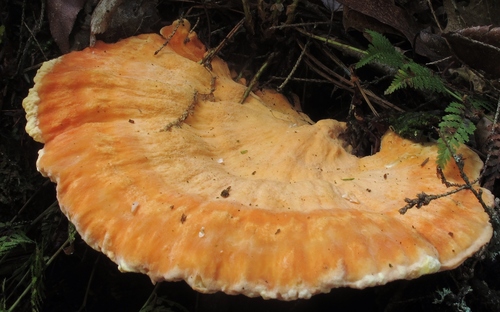
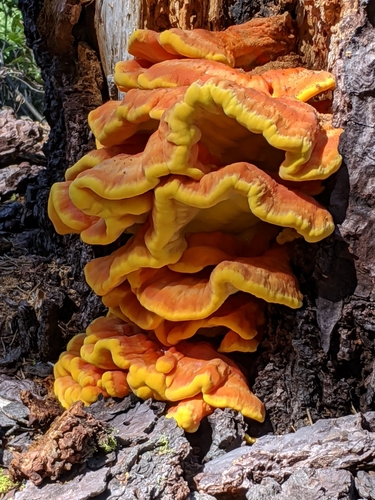
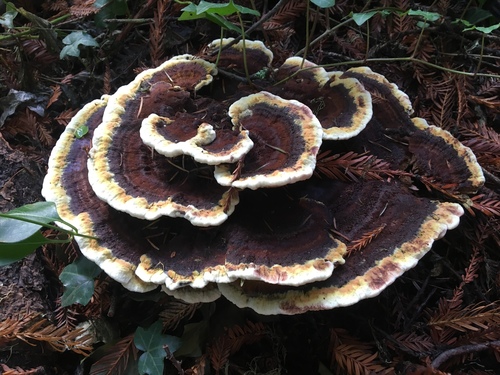
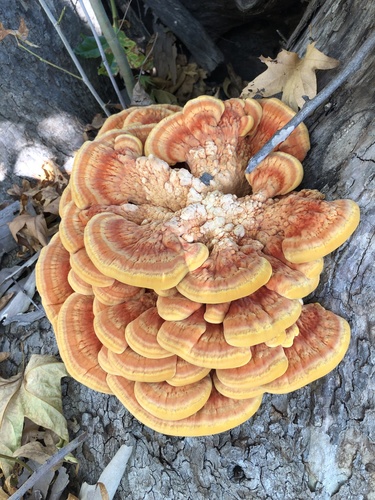
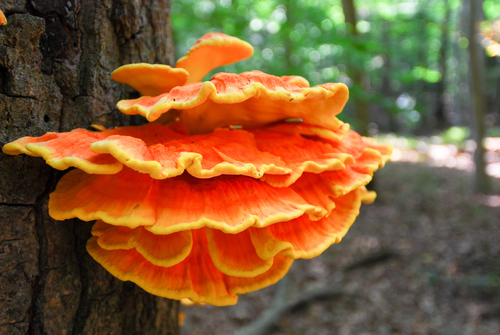
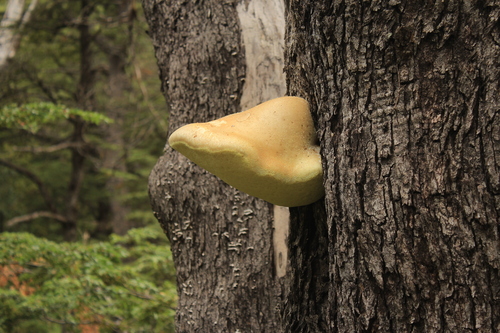
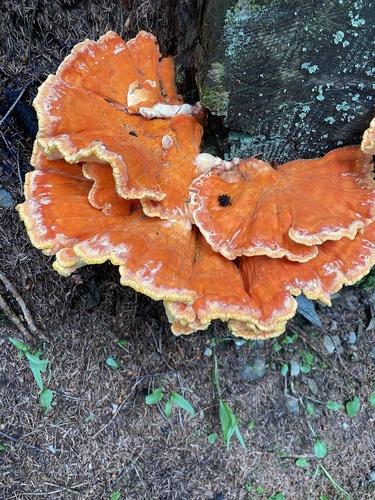
The fruitbodies of Laetiporus montanus are made up of overlapping fan-shaped caps that can reach up to 30 cm (12 in) wide and 1–3 cm (0.4–1.2 in) thick. When young, the upper surface of the fruitbody is bright orange, and it fades to a light brownish color as the fungus ages. The pores found on the underside of the cap start out bright yellow, then fade to pale tan as they mature. These pores are small, with between 1 and 4 pores per millimetre. The spores of Laetiporus montanus are egg-shaped, hyaline (translucent), and measure 6.0–8.0 μm. This species has larger spores than other European Laetiporus species; for comparison, the spores of L. sulphureus typically do not grow longer than 7.0 μm. Like all species in the Laetiporus genus, L. montanus causes brown rot in the host trees it grows on. It grows on mature conifers, most commonly Picea abies and Larix decidua. In Europe, this fungus has been officially recorded in the Czech Republic, Slovakia, and Austria. In 2010, it was reported from the Inner Mongolia Autonomous Region, marking the first confirmed record of the species in China. The full current distribution of L. montanus is not well understood. Researchers suspect it may have a wider range that includes Switzerland and neighboring mountainous countries. This fungus only grows at elevations above 1,100 m (3,600 ft). Two species of Diptera, Ula bolitophila and Spelobia parapusio, are known to rear their young inside the fruitbodies of L. montanus.