About Laetiporus conifericola Burds. & Banik
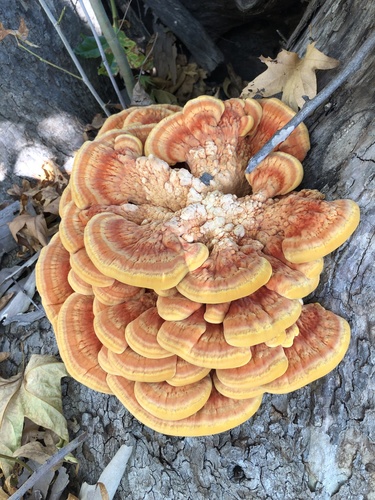
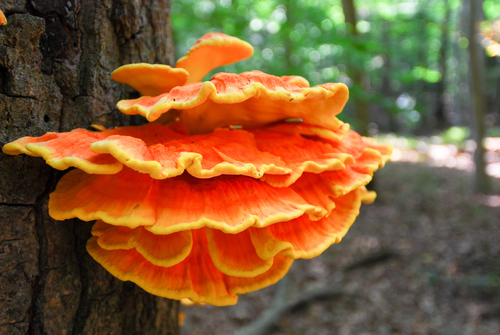
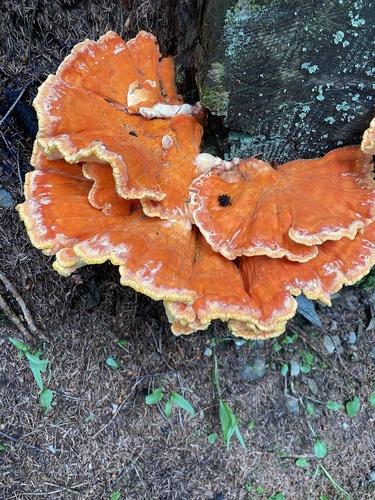
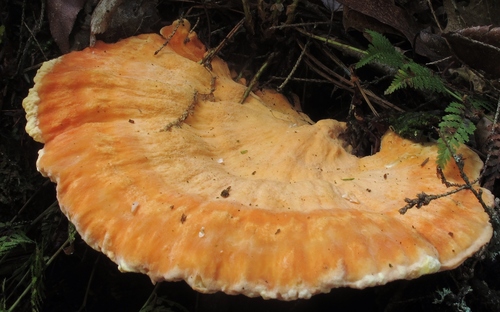
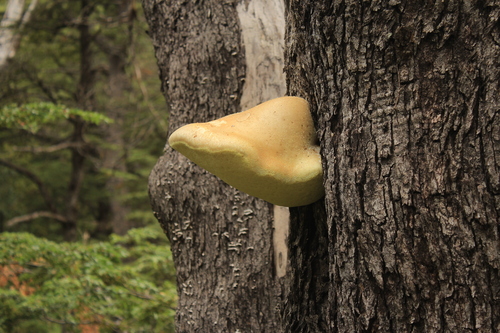
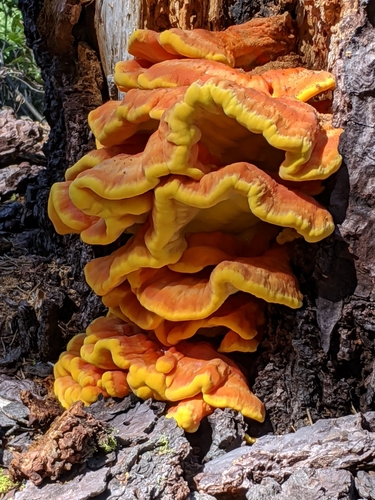
Laetiporus conifericola is a polypore fungus species belonging to the Fomitopsidaceae family. It is distributed in western North America, ranging from California to Alaska. The fungus grows as a plant pathogen on conifer trees, most commonly fir, spruce, and hemlock. Its fruit bodies are made up of overlapping pore-bearing plates; when measured together, these plates can reach up to 60 cm (24 in) across and up to 4 cm (2 in) thick. The upper surfaces of the cap and stipe range in color from bright orange to salmon orange, while the pore surface on the underside of the cap is yellow. The species produces egg-shaped, smooth, hyaline (translucent) spores that measure 6.5–8.0 by 4.0–5.0 μm. Fresh specimens of Laetiporus conifericola have a pleasant odour. This species was first described as new to science in 2001 by mycologists Harold H. Burdsall and Mark T. Banik. The type collection for the species was collected on the Kenai Peninsula, Alaska, in October 1999. Laetiporus conifericola can be told apart from other species in the Laetiporus genus by its growth habit on conifers. Before it was confirmed as a separate species, it was often misidentified as L. sulphureus, an eastern North American Laetiporus species that grows on hardwoods. It is also similar in appearance to L. gilbertsonii. Laetiporus conifericola is generally considered edible, but some people have experienced gastrointestinal upset after eating it. Young specimens with soft flesh, or the fresh outer margins of older fruit bodies, are considered the best portions for eating, and thorough cooking is recommended.