About Lacuna vincta (Montagu, 1803)
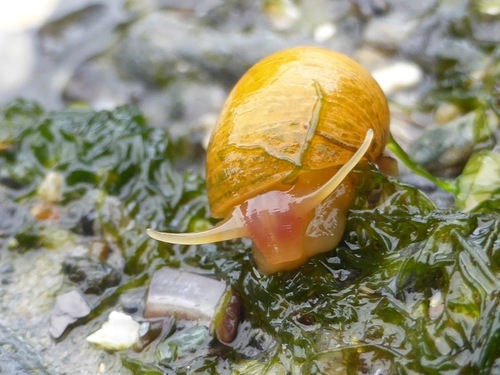
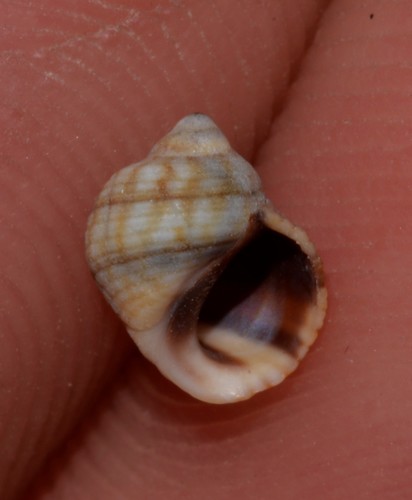
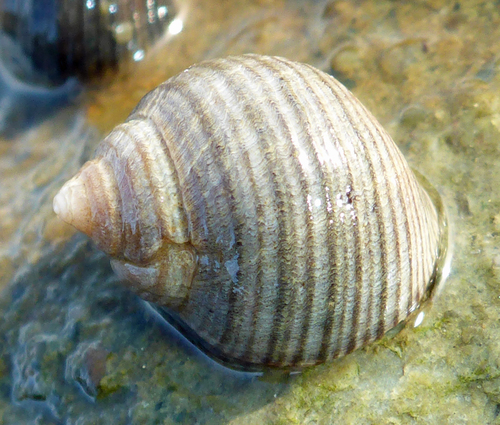
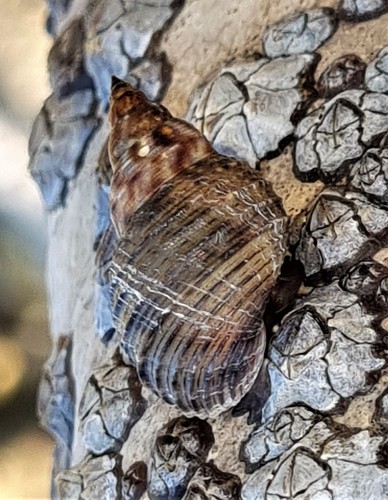
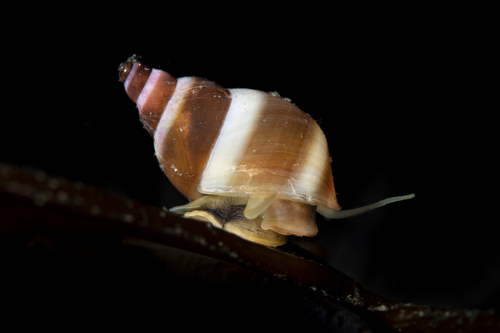
This sea snail species has the accepted scientific name Lacuna vincta (Montagu, 1803). Its shell is conical, with five to six smooth whorls and a pointed apex. The aperture is about half the shell's total height, or slightly larger. The umbilicus has a prominent groove between two white ridges of the columella. The shell exterior is pale brown with a broad white spiral band, and covered in a glossy periostracum. The shell interior is not white and pearly, and the aperture can be closed by an operculum. The maximum recorded shell length for this species is 13 mm (0.5 in). Lacuna vincta has a circumboreal distribution. In the Atlantic Ocean, its range extends south to the British Isles, France, and the eastern coast of North America. In the northeastern Pacific, its range stretches from Alaska to California, though it is rarely found further south than Washington state. This species lives on algae in rocky shore habitats, found intertidally and at depths down to about 40 m (130 ft). In the British Isles, its larvae settle preferentially on brown seaweeds such as Fucus serratus and Laminaria spp., short red seaweed such as Lomentaria articulata, and the seagrass Zostera spp. In the Pacific, its larvae settle mainly on kelp, eelgrass, and surfgrass. Lacuna vincta is a herbivore that grazes on seaweed and on diatoms that grow on the surface of seagrasses. Its radula holds 45 to 95 rows of tiny teeth, with approximately three new rows formed each day. This species produces two distinct types of teeth: when the snail grazes on seaweed, newly formed teeth are sharply pointed to tear deeply into algal fronds; when the snail feeds on diatoms growing on seagrass, new teeth are much blunter, used to scrape diatoms off seagrass leaves. New teeth form at the back of the radula and gradually move forward as older teeth wear away and are discarded. This means it takes some time for the snail's teeth to adjust to a change in diet. The snail prefers sheltered positions, and in exposed areas it seeks shelter in crevices or dense patches of seaweed. When conditions are unsuitable, such as during food shortages or when predator numbers are excessively high, it can produce a string of mucus that it uses as a parachute to drift to a more favorable location. This snail has separate sexes, and females lay eggs in a ring shape on seaweed or seagrass. Eggs can be laid year-round, but in some locations including the British Isles, they are laid in spring and early summer, after which the adult snails die. Eggs hatch after approximately six days, and the veliger larvae are planktonic for up to six months before settling on the shallow seabed when their shell reaches about 1 mm (0.04 in) in length. In eastern Canada, juvenile snails of this species have been recorded at a density of 1500 individuals per square meter.