About Lactoria diaphana (Bloch & Schneider, 1801)
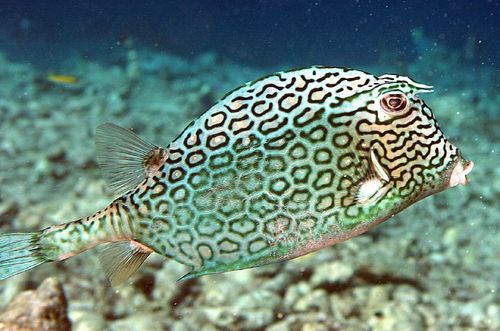
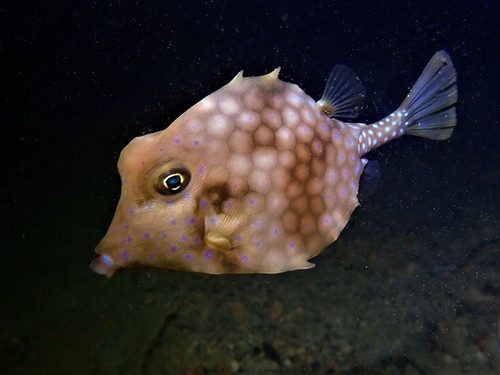
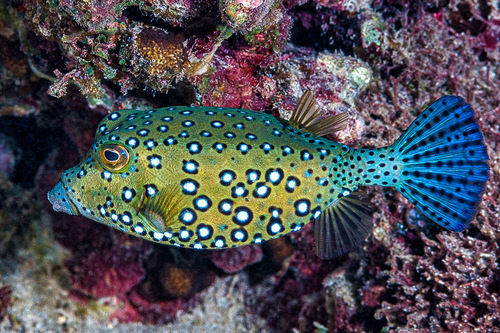
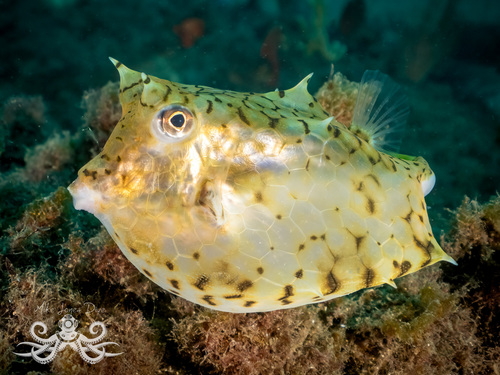
Lactoria diaphana, commonly called the roundbelly cowfish, has a thick, rectangular body that is mostly enclosed in a carapace formed by thickened, hexagonal, plate-like scales connected to one another. There are five horizontal ridges on the carapace: one poorly developed ridge along the back, and a pair of upper and lower ridges on each flank. A large spine grows above each eye, a spine sits at the rear end of each lower flank ridge, and a spine is located halfway along the back ridge. It has small mouths positioned at the front of the snout, with fleshy lips and a row of no more than 15 moderately sized conical teeth in each jaw. The gill slits are short and oblique, and sit in front of the pectoral fin bases. The dorsal and anal fins are located at the back of the carapace, the caudal peduncle is thin and flexible, and the caudal fin is fan-shaped. Both the dorsal fin and anal fin have 9 soft rays. The dorsal profile of the snout is steep and concave, while the ventral profile of the body is rounded. The overall body is pale greenish-grey, patterned with honeycomb reticulation and brown blotches. This species reaches a maximum total length of 34 centimetres (13 inches). Lactoria diaphana has a wide distribution across the Indo-Pacific region. Its range stretches from the eastern coast of Africa off Mozambique and South Africa in the western Indian Ocean, through the Indian and Pacific Oceans, all the way to the eastern Pacific between Santa Barbara, California and Chile. It can be found as far north as Japan and as far south as Tasmania. It is the only member of the genus Lactoria with a range that extends into the southeastern Atlantic, occurring around the Cape of Good Hope and along the southwestern coast of Africa as far north as Swakopmund, Namibia. The roundbelly cowfish inhabits coastal and outer reefs, at depths down to 50 m (160 ft). Juveniles are semi-transparent and live in pelagic waters near the surface. Like other boxfishes, this species (also referred to as the thornback cowfish) can release a soap-like toxin called pahutoxin through its skin when stressed. This toxin can incapacitate or even kill potential predators. One recorded case in Japan involved a human death from palytoxin poisoning after ingesting the flesh of this species.