About Lactarius vinaceorufescens A.H.Sm.
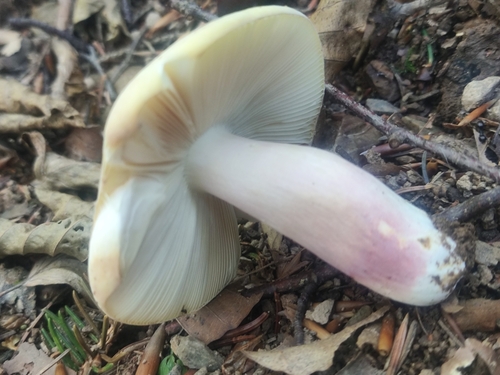
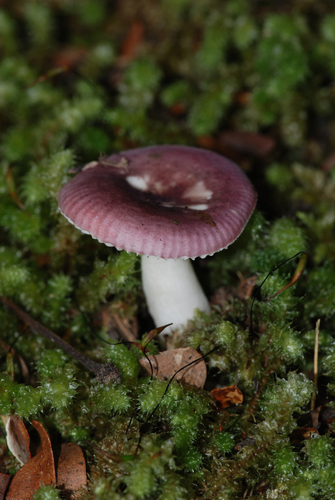
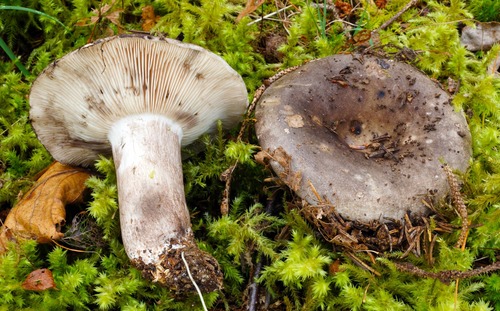
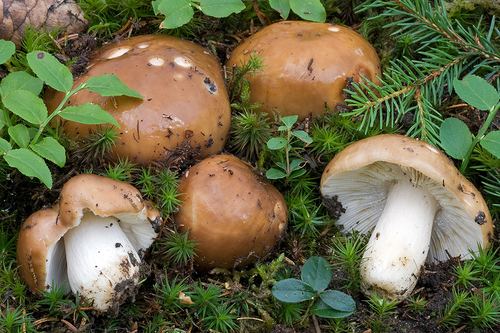
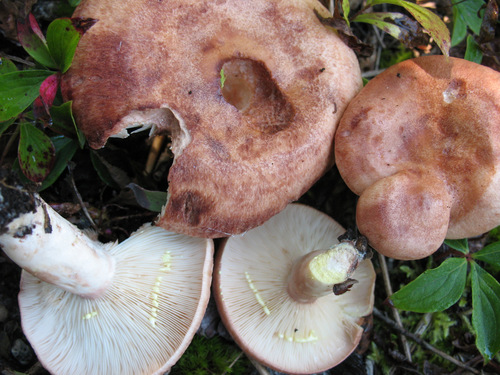
The cap of Lactarius vinaceorufescens is convex when young, before maturing into a broadly convex to almost flat shape, reaching a diameter of 4–12 cm (1.6–4.7 in). When young, the cap margin is rolled inward, then expands as it ages, eventually becoming somewhat uplifted and uneven. The cap surface is smooth; young specimens have a pale pinkish cinnamon color with pinkish buff coloring at the margin, while older specimens darken to pinkish cinnamon to orangey cinnamon. Faint near-monochromatic zones or water spot markings are visible on the cap. The gills are attached to slightly decurrent, narrow, closely spaced, and often forked near the stem. Multiple tiers of lamellulae—short gills that do not extend fully from the cap margin to the stem—are present. Young gills are whitish to pinkish buff, and develop wine red (vinaceous) to pinkish brown to dark reddish brown spotting as they age. When the mushroom is cut or injured, the exuded latex is initially white, then rapidly changes color to sulfur-yellow. The stem measures 4–7 cm (1.6–2.8 in) long by 1–2.5 cm (0.4–1.0 in) thick, is roughly equal in width along its length or slightly wider toward the base, and is hollow inside. The stem surface is nearly smooth, with white to brownish stiff hairs at the base, and is pinkish-white overall, darkening with age. The flesh is moderately thick, white to pinkish, and stains bright sulfur yellow when injured. The mushroom has an acrid taste. The spore print is white to yellowish. Spores are roughly spherical to broadly ellipsoid, hyaline (translucent), and amyloid, measuring 6.5–9 by 6–7 μm. They are ornamented with warts and ridges that sometimes form a partial reticulum, with prominences reaching up to 0.8 μm. The spore-bearing basidia are four-spored, measuring 28–33 by 8–10 μm. Young pleurocystidia (cystidia on the gill faces) are roughly cylindrical to narrowly club-shaped, but quickly widen at the midsection and taper to an abrupt point, reaching dimensions of 40–68 (up to 80 μm) by 9–13 μm. Cheilocystidia (cystidia on the gill edges) are roughly club-shaped or ventricose with sharp apices, and measure 32–44 by 6–10 μm. Clamp connections are absent from the hyphae. The cap cuticle is a thin ixocutis made of gelatinous hyphae that are typically 2–4 μm wide. Numerous connective hyphae ends project 5–15 μm long out from the cuticle surface. Fruit bodies of Lactarius vinaceorufescens grow scattered or in groups on the ground under pine trees between August and October. This species forms mycorrhizal associations with Douglas fir (Pseudotsuga menziesii). It is a fairly common, widely distributed species in North America. It has been recorded in boreal forests and high-elevation forests of the Southern Appalachians, growing in association with trees in the genera Picea, Abies, and Pinus. In California, it is commonly found growing alongside L. fragilis, L. rubrilacteus, Russula emetica, and R. cremoricolor. This mushroom is poisonous. Following general guidance in multiple mushroom guide books, consumption of any Lactarius species with yellow-turning latex is recommended to be avoided.