About Lactarius turpis (Weinm.) Fr.
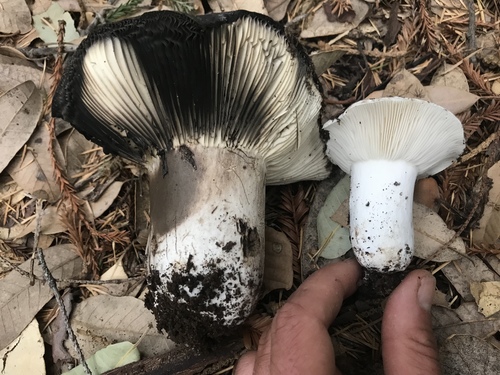
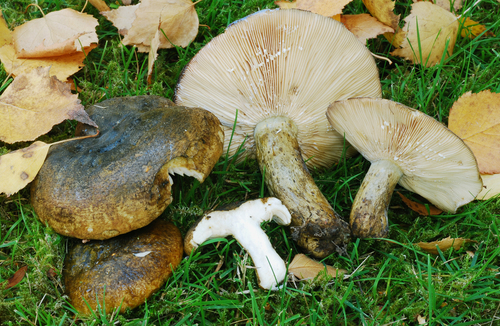
This mushroom species, Lactarius turpis, has caps that normally measure 4–20 cm (1.5–8 in) in diameter. Young caps have an involute margin, a somewhat depressed center, and an upper surface that is olive brown or yellow-green, often sticky or slimy across the middle. Young caps have velvety zones and may be shaggy at the rim. As the mushroom matures, the cap becomes funnel-shaped and darkens to blackish. The gills are crowded, dirty white, stained olive-brown by old latex (milk), which starts white when exposed to air. The gills are somewhat decurrent. They produce a purple reaction when exposed to potassium hydroxide or ammonia. The stipe grows up to approximately 7 cm (2 3⁄4 in) tall and 3 cm (1 1⁄4 in) in diameter, and matches the cap in color but is much lighter. It may have shallow pits called scrobiculae. The flesh is dirty white and tends to turn brown when cut. Both the flesh and the abundant milk have an acrid taste. The mushroom has very little noticeable scent. Spores measure around 7 by 6 μ and are ornamented with a ridge-like pattern. The spore print is cream colored. Lactarius turpis is native to Europe and Siberia, and has been introduced to Australia and New Zealand. It also grows in North America, where it appears in the northeast from July to September and near the West Coast from September to November. It is especially associated with birch trees, but also grows with spruce, pine, and other trees in mixed woodland.