About Lactarius tabidus Fr.
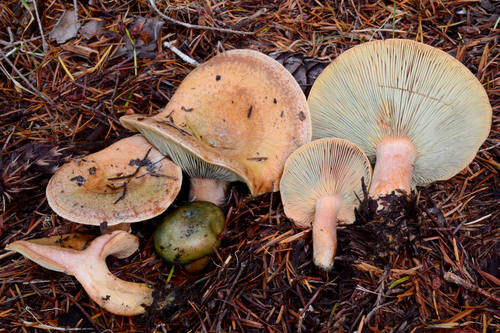
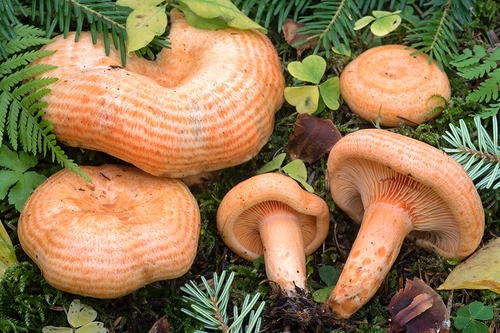
Lactarius tabidus Fr. is characterized by a convex cap measuring 2.5 to 7 centimeters across, which often has a central umbo and flattens as it ages. The cap ranges in color from liver to dull chestnut, with a dry, matte surface. Its margin often bears tiny lobes, and can be crimped or crisped. The stem is typically 3 to 7 centimeters tall and 4 to 8 millimeters wide, and ranges in color from reddish-brown to brick-colored. The thin cap flesh is a pinkish buff tinted with white, and both the stem and cap become hollow as they age. The pale buff gills are slightly decurrent; with age they turn deep buff to pale ochre, sometimes developing a faint mauve tint. This species produces white milk that dries yellow, and stains fabric sulfur yellow within minutes. The spore print is cream. Spores are broadly elliptic with large warts: most warts are connected by thin to moderately thick ridges that form a very incomplete network, while other warts remain isolated. Spores measure 8 to 9 micrometers by 6 to 7 micrometers. Lactarius tabidus grows under pine or birch during autumn, and thrives in leaf litter or Sphagnum moss. It is common in southern Britain, growing rarer further north, and can also be found in North America.