About Lactarius rufulus Peck
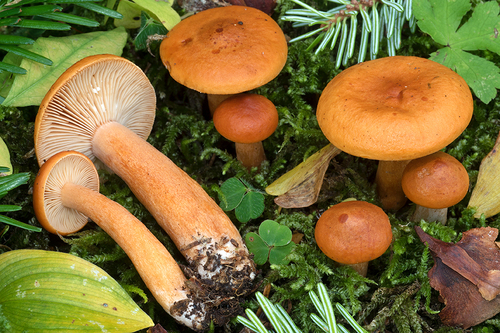
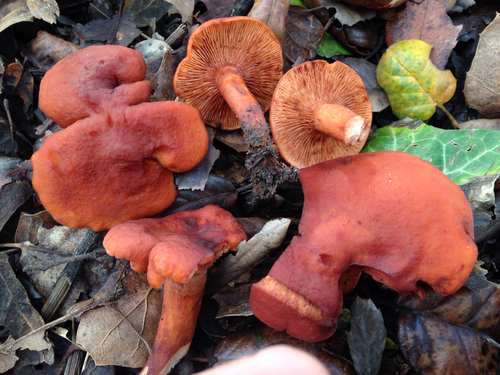
Lactarius rufulus Peck, commonly abbreviated to L. rufulus, has a cap that ranges from 3 to 10 cm (1.2–3.9 in) wide. It starts broadly convex, becomes flattened over time, and eventually develops a shallow funnel shape, sometimes with a small, raised central bump called an umbo. The cap margin (outer edge) is initially curved inward, and curves upward as the mushroom matures. The cap surface is usually uneven or wrinkled. It starts brownish red, and fades to orange-brown as it ages. The gills attach to the stem either squarely (adnate) or run slightly down the stem length (subdecurrent). Gills are packed closely together; they start pinkish-yellow, and darken to red or reddish brown with age. The gills are not forked, and do not change color when bruised. The stem is 4–8 cm (1.6–3.1 in) long, and 0.5–1.5 cm (0.2–0.6 in) thick. It is roughly equal in width along its length or slightly wider toward the bottom, with a dry, smooth, reddish brown surface. It may be solid or stuffed with cotton-like mycelia, and can become partially hollow as it ages. The flesh is firm, ranging from white to pinkish-orange, and does not change color when cut. The latex (milky sap) is produced in small amounts, is white, does not change color after exposure, and does not stain mushroom tissues. The mushroom has a mild taste, and produces a spore print that ranges from white to creamy yellow. Microscopically, the spores measure 7–9 by 7–9 μm, are spherical or nearly spherical, and are ornamented with a partial to complete network of raised, net-like ridges called a reticulum, with ridges reaching up to 0.5 μm high. The spore-bearing cells (basidia) are both two-spored and four-spored, and measure 45–52 by 9–11 μm. The cap cuticle is a poorly formed layer of inflated cells, with scattered filamentous cystidia on the cap (pileocystidia). Somewhat unusual for the Lactarius genus, L. rufulus lacks swollen cells called sphaerocysts in its cap and stem, or has very few of these cells. Lactarius rufulus is a mycorrhizal species that forms a mutualistic ectomycorrhizal association with oak species: the fungus grows an external sheath that surrounds the oak's small rootlets. The fungus gets soluble carbohydrates that are byproducts of the oak's photosynthesis, and in turn gives the oak better access to nutrients from the soil needed for growth. The mushroom's fruit bodies grow scattered or in groups on the ground under oak trees, usually fruiting from January to March, and are uncommonly encountered. Originally thought to occur only in California, where it is most common in the southern part of the state, it was reported in Mexico in 1998 and in Arizona in 2006. This mushroom is edible, with a mild taste and a faint odor of maple syrup. American author David Arora notes that its fruit bodies can be used similarly to candy cap mushrooms, though they are not as fragrant. Chefs in the San Francisco Bay Area are known to use this mushroom in desserts including ice creams, cakes, and caramels.